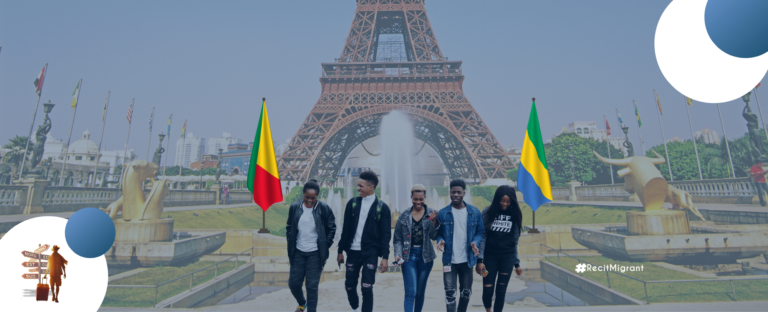
The path of young Africans in search of skills and opportunities in the West is often filled with twists and turns across various countries. Most of the time, these journeys are a collective family project, meticulously planned by parents, relatives, and occasionally aided by their connections. Olivia’s narrative illustrates this experience, as shared with Dialogue Migration, against a backdrop of tightening requirements for securing a student visa to France.
The young woman we’ll know as Olivia is a Beninese woman in her twenties. Her dream is to complete her studies in Europe. In order to make the most of her chances, she decided, with her parents’ help, to study in Gabon, where she obtained her high school leaving certificate.
Like her, many young Africans who cherish the dream of the West, decide to spend part of their studies in another African country, in the hope of bettering their chances of migrating legally to Europe or other Western destinations.
The young woman, though resolute, kept her comments to a minimum during our interactions. Her plans for the future are shrouded in a veil of secrecy which may seem strange, but for her, that makes perfect sense.
This discretion also reflects the cautious approach with which some young people embark on their migration plans. In families that sometimes devote significant resources to tuition and administrative procedures, the dream of European migration becomes a collective endeavour, carefully crafted. Even if this dream comes up against pitfalls, other options exist.
Tighter Conditions for Obtaining a Student Visa to France
The status of international students in the West is often viewed through the broader perspective of migration policies. Yet, behind the figures and administrative measures we find young people in search of education, skills and new opportunities.
Against a backdrop of tightened migration controls, the French government has introduced stricter financial requirements for students wishing to enrol in higher education in France.
With effect from 1 August 2026, the minimum monthly income required to obtain a student visa has risen from 615 to 877.50 euros per month, equivalent to approximately 10,525 euros per year.
This measure forms part of a series of reforms aimed, in particular, at strengthening financial autonomy guarantees for applicants and better monitoring student immigration. For many young Africans and their families, however, this new requirement adds to the obstacles on a path already burdened with administrative and financial constraints.
A Decision That Has Triggered a Reaction From Certain Governments
In response to the increase in the financial threshold required by France for student visas, Gabonese President Brice Clotaire Oligui Nguema has announced the suspension of State scholarships to Europe for new A-level graduates, giving priority rather to the excellent quality at some African and local institutions.
The Gabonese authorities find it very difficult to comply with the increased financial requirements imposed by the French government, particularly as public finances do not allow for a proportionate increase in support for state-funded students.
The Gabonese government is therefore encouraging young people to look more towards local and continental higher education institutions, one way of championing the idea that the future of African talents need not necessarily be shaped overseas.
This decision also highlights the indirect implications that European migration policies can have on the educational choices of African countries and on the mobility plans of their young people.
Paris Against All Odds…
Olivia, for her part, is steadfast in her plans and remains hopeful that success will come in the end.
Despite facing countless obstacles in her quest to realise her dream, nothing seems to have dampened her enthusiasm. Her goal is clearly defined and her path is firmly mapped out.
She believes in her chances and promotes the benefits of cultural diversity, exchange and the sharing of knowledge. For her, going to study in Europe is not just about graduating with a degree. It is also about discovering a different environment, acquiring new skills and broadening her prospects.
Like her, many others are nurturing this dream: to go to the West to study, acquire skills and return, perhaps one day, use that knowledge to serve their own country.
Yet returning home after a successful academic career in European universities comes with a whole new set of challenges. Between career prospects, the conditions for reintegration and the opportunities that exist in their home countries, the journey back remains paved with pitfalls.
From Cotonou to Libreville, Olivia’s journey thus depicts a wider reality: for some young Africans, the migration project begins long before a visa is issued. It is shaped within the family, organized across several countries and fueled by a dream: that of an education in the West, seen as a gateway to new possibilities.