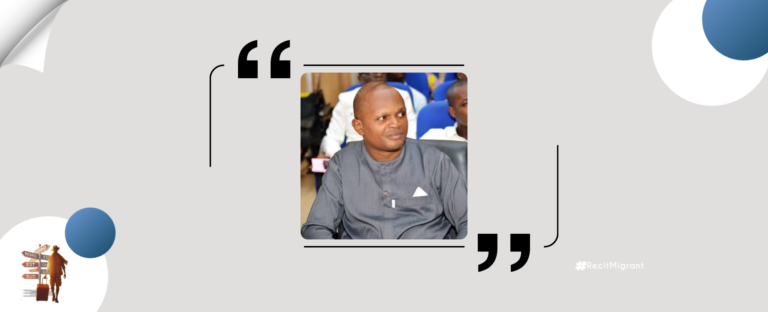
Mr SESSI Sefiamenou Yao Expert on Youth, Peace and Development – Lecturer and Researcher – Specialist in Community Development
The relationship between mobility, youth, peace and security is becoming increasingly prominent in debates on migration dynamics in Africa. Restrictions on legal migration routes, forced displacement, unemployment, conflict, violent extremism and identity-based tensions can all intertwine in young people’s life trajectories. In this section, Mr SESSI Sefiamenou Yao analyses the challenges associated with mobility in fragility-prone settings and puts forward ways to turn the movement of young people into a driver of social cohesion and development. The answers below are based on the content provided by the expert.
“Restrictions on Mobility Can Exacerbate Certain Vulnerabilities”
Dialogue-Migration: As an expert, do you see a direct correlation between restrictions on legal mobility and an increased risk of insecurity or recruitment by extremist groups?
Mr SESSI Sefiamenou Yao: Yes, there is an indirect but meaningful correlation between restrictions on legal mobility and increased vulnerability to insecurity, including recruitment by extremist groups. However, this relationship is neither automatic nor mechanical: it is shaped by socio-economic and institutional factors.
When legal avenues for mobility are limited, costly or inaccessible, some young people find themselves trapped in a situation where opportunities are structurally denied. This sense of being excluded can lead to frustration, despair and a loss of trust in institutions.
Against this backdrop, extremist groups can prey on these vulnerabilities by offering alternative identities, economic or social opportunities, often presented as forms of recognition or emancipation.
Thus, restrictions on legal mobility can indirectly fuel dynamics of insecurity when they are not offset by policies promoting inclusion, employment and social protection.
Generally speaking, African countries have to contend with this phenomenon for several reasons, and unemployment is a major factor. If left unchecked, these frustrations can drive young people to the point of no return.
‘Young Displaced People Should Not Be Viewed as Passive Victims’
Dialogue-Migration: In conflict zones, displacement is often forced. How can we ensure that young displaced people’s potential for development is safeguarded, so that they do not become a “lost generation”?
Mr SESSI Sefiamenou Yao: In conflict-affected areas, the priority is to transform forced displacement into protective and productive mobility. Displaced young people must not be viewed as passive victims, but as potential agents of resilience.
The first step is to provide immediate access to education and training, even in emergency situations, through mobile, digital or community-based initiatives.
Secondly, it is paramount to set up psychosocial support systems, as mental recovery is a prerequisite for any social and economic recovery.
Furthermore, integrating youngsters into income-generating activities and local projects helps to preserve their dignity and their social role.
Finally, coordination between States, humanitarian agencies and local players is crucial to preventing disruption to their life trajectories.
The challenge, therefore, is to turn displacement into a path to resilience rather than a path to exclusion.
“Young displaced people must not be viewed as passive victims”
“Resolution 2250 Acknowledges Young People’s Role in Peace and Security”
Dialogue-Migration: How does United Nations Security Council Resolution 2250 address displacement and borders?
Mr SESSI Sefiamenou Yao: United Nations Security Council Resolution 2250 provides a major normative framework recognising the role of young people in peace and security. Although it does not deal exclusively with borders, it implicitly embraces the issue of mobility across several dimensions.
It promotes youth participation at all levels of decision-making, including in cross-border and regional contexts. It also recognises that young people, particularly those who are displaced and refugees, must be protected and included in peace processes.
Furthermore, it emphasises the prevention of violent extremism, which entails placing particular attention on the factors driving forced displacement, exclusion and marginalisation.
Resolution 2250 thus indirectly regards the dynamics of mobility as a central element of sustainable peace, calling for inclusive policies that go beyond administrative borders.
The African Youth Charter also places great emphasis on peace and security for young people. In particular, States are called upon for further involvement in conflict prevention and peacebuilding, to promote education for peace, tolerance and intercultural understanding, to confront the recruitment of young people into armed conflict and violent extremism, to protect young people from violence and the harmful effects of conflict, and to support the reintegration of displaced young people and victims of war.
Young people are therefore not merely a group to be protected: they must be regarded as strategic players in peace and security in Africa.
“Mobility Entails Encountering Others”
Dialogue-Migration: Mobility leads to the mixing of populations. How can we educate young people about a form of mobility that promotes social cohesion rather than identity-based tensions?
Mr SESSI Sefiamenou Yao: Educating young people about mobility that fosters social cohesion requires a shift in attitudes at an early age. This means instilling values of tolerance, diversity and global citizenship within education systems.
Young people must be taught to understand that mobility involves encountering others, and therefore the necessity of respecting cultural, religious and identity-based differences. A clear understanding of the importance of such mixing would avoid enormous losses.
Peace education programmes, intercultural exchanges and community initiatives are key to building this understanding. With the rise of local authorities in our countries, local councillors and youth clubs should join forces to educate the public.
The media and opinion leaders must also promote positive narratives about mobility, in order to counter narratives of fear or rejection.
In short, social cohesion in the context of mobility rests on education in responsibility, openness and living together.
This also depends, however, on the situation in the country. If social insecurity has become the norm, many young people will be forced to leave their country and may not even want to return.
Afterwards, we will find ourselves complaining about the brain drain, even though the minimum conditions had not been met to keep them there or, at the very least, to make them feel like returning. Traumatic memories mean that many feel they had a narrow escape.
“A Safe Space for Free Movement as a Strategic Project”
Dialogue-Migration: A Safe Space for Free Movement for Young People…Is it Utopia or a Feasible Project?
Mr SESSI Sefiamenou Yao: A secure area of free movement for young people is not a utopia, but a progressive and achievable project, provided it is underpinned by strong political will and effective regional cooperation.
In the short term, its realisation depends on strengthening regional integration mechanisms, mutual recognition of qualifications and the facilitation of legal migration procedures.
However, such a space cannot be sustainable without a joint effort aimed at enhancing security, governance and economic opportunities in the countries concerned.
The objective is therefore not merely physical freedom of movement, but the creation of a secure, equitable and inclusive environment, where mobility becomes a contributing factor to peace and development.
Thus, this space is less a utopia than a strategic project requiring a gradual, realistic and coordinated approach involving States, regional organisations and international partners.
If the objective is truly a shared one, then why not pursue it along a path paved with peace, free from thorns and vines?