From Chad to France through Burkina Faso, Nékouanodji Eve is creating a cinema inspired by her travels and encounters. A portrait of a young filmmaker who navigates a path between a deep attachment to her roots, an embrace of the world, and the pursuit of a personal artistic voice.
Some artists depict the world from a stationary point. Nékouanodji Eve, however, observes it while on the move. Her points of reference shift, her experiences pile up, and her camera captures, observes and questions. Between Chad, her country of origin and France, where she is currently training in documentary filmmaking, the young filmmaker moves forward like an attentive traveller, always open to what other societies, other cultures and other life journeys can teach her.
“For the moment, I can’t really give you the name of the country where I live. Like a pilgrim, I roam the world. I am here and there,” she says, defining herself as a world citizen. Behind this phrase lies not so much a lack of roots as a particular way of inhabiting the world: through curiosity, observation and encounters.
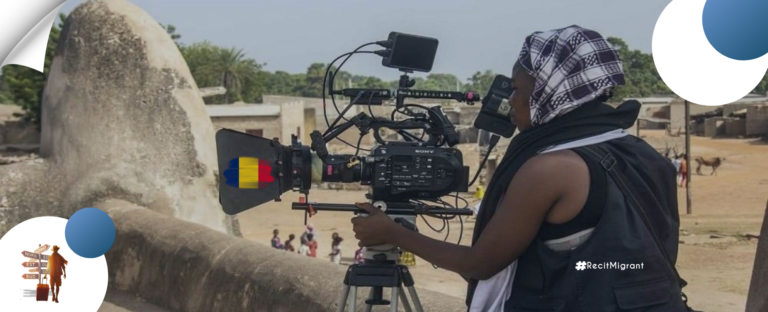
Eve is a young woman with a passion for images and stories. Her journey progressively reveals a creative, sensitive and strong-willed personality. For her, the camera is a tool for exploration, but also a means of understanding others and understanding herself.
Her first profile published in the Chadian press already portrayed her as a young woman with ‘magnetic fingers’ who is fascinated by the camera. This image perfectly sums up her approach to creativity: for Eve, filming is not merely about handling a camera or arranging shots. It is about seeking out what lies behind appearances, paying attention to silences, gestures, emotions and contradictions.
The filmmaker embraces this role as an observer. She observes closely, learns, analyses and strives to understand before passing judgement.
“I draw inspiration from everything I see. I feed off the encounters, the journeys and the experiences of those I meet,” she explains.
This attitude gives her films a profoundly human touch. For her, travelling is not merely a sequence of journeys. It becomes a learning experience. Every place she visits, every encounter and every cultural distinction helps to expand her perspective.
Leaving Without Leaving Yourself Behind…
Nékouanodji Eve’s life story can be interpreted as a migratory experience, even though she herself is uncomfortable with the term. Rather, she speaks of mobility, travel and discovery.
For her, leaving Chad does not necessarily mean turning her back on her country. On the contrary, the distance seems to further strengthen her beliefs in certain values and ways of seeing the world. She stays true to an upbringing, a culture and a set of values that she strives to carry on.
Openness to the world does not erode her roots. It brings them into dialogue with other experiences. Eve draws from others what can enrich her creative work, whilst refusing to compromise what she considers essential to her African identity.
“There are things I prefer to keep intact, things from home, from Africa,” she states proudly.
This statement sums up one of the major challenges of her journey: how can one open up to the world without losing oneself in it? How can one learn elsewhere without giving up who one is? For Eve, the answer requires a balance between listening, discerning and remaining true to oneself.
Living far from home is not always associated with freedom or fulfillment. The experience of living abroad also comes with its share of challenges. Eve rejects the idea that leaving means having escaped the struggles.
“Just because we’ve left doesn’t mean we no longer have struggles,” she points out.
Far from Chad, she realised that distance can sometimes make struggles more complicated. You have to adapt to new norms, understand different ways of working, carve out a place for yourself and be willing to start afresh. The distance from loved ones, loneliness, uncertainties and the need to learn to stand on one’s own two feet quickly are all part of this experience.
“Living far from home makes you grow up very quickly,” she observes.
This maturity acquired through displacement shapes her perspective as a filmmaker. It enables her to view identities as living, human realities – in flux, never entirely fixed. She also understands that people who migrate do not necessarily leave their country because they have ceased to fight. Sometimes, they leave precisely to fight their battle in a different way, to seek new opportunities or to build a path that did not yet exist.
Eve is convinced that Africans have lots of resources and talents. She advocates a pan-African vision based on self-confidence and the ability to build things locally.
“We have potential here at home. We can succeed anywhere if we have the will,” she maintains.
Her journey away from her homeland therefore does not conflict with this view. It adds to it. Leaving may be a way of learning, of returning with a fresh perspective, of building bridges and helping to raise awareness of her country’s realities beyond its borders.
See also: Pélagie Nabolé’s struggle to reconnect with her culture
The Documentary as A Form of Self-Revelation…
For Nékouanodji Eve, making a documentary film is tantamount to laying oneself bare. Filming means agreeing to reveal a part of oneself, even when the subject seems to belong to others.
“Making a film, especially a documentary, is like taking your clothes off. It’s about laying yourself bare, opening yourself up to the world,” she confesses.
This closeness to filmmakers who dare to tell their own stories has a profoundly transformative effect on her. It gradually leads her to envision a more personal, daring and vulnerable creative process.
But telling one’s own story is no easy matter. It requires a willingness to confront painful memories and face truths that one would sometimes prefer to leave in the shadows.
This is what happened with her film project on mourning, entitled e-deuil. Initially, she wanted to explore how mourning has changed in the age of new technologies and contemporary transformations. But discussions with her instructors prompted her to question her own intimate relationship with the subject.
The questions led her to reflect on her own relationship with love, loss and emotions. Eve then wanted to give up the project, because she wasn’t ready to face certain inner realities.
Between Technology, African Representations
The experience of mobility directly shapes the subjects Eve chooses to explore, as evidenced by her film project E-Deuil. This choice reflects her receptiveness to international topics and issues that are sometimes still largely absent from the collective imagination of her immediate surroundings.
This reflection highlights an important question for African filmmakers, namely ‘must one necessarily address the same topics, use the same conventions and adhere to a traditional representation of Africa in order to be understood and accepted?”
Her perspective, however, is far from a rejection of African culture.
She recognises the importance of sensibility, family connections, emotions and memory in African societies. Rather, she seeks to create a dialogue between these dimensions and new issues. Her cinema could thus be situated at the crossroads of several worlds: Chad, Burkina Faso and France; Africa and the wider world; memory and modernity; the personal and the collective.
The Journey as A Space for Creative Expression
But beyond her training, she continues to find inspiration for her art in her experience of mobility. Chad has given her memories, values and a particular sensibility. France has provided her with another space for learning and reflection. Her travels, encounters and movements have added further depth to her perspective.
Nékouanodji Eve thus moves forward with the firm belief that one must sometimes leave in order to see better, but also to learn to look at one’s own home with fresh eyes. Her journey cannot be narrowed down to migration, education or an artistic career alone. It is a perpetual quest for balance between here and elsewhere.
Along this road, Eve films, observes, learns and tries to forge her own path. As she says with determination: ‘even when conditions are tough, you have to give it a shot’. Because sometimes, leaving does not mean giving up. It also means seeking the strength, the tools and the images needed to return to one’s beloved ones in a different light. Good luck, artist!