The Mediterranean no longer washes up only debris and bodies; it is starting to wash up evidence. This spring of 2026, the silence around Frontex’s operations is cracking in the French courts. Frontex began as a small coordination agency and grew into a military power with 10,000 guards. Now it must answer for its choices through its former Executive Director, Fabrice Leggeri. Prosecutors accuse the former border chief, now a Member of the European Parliament, of complicity in crimes against humanity, and his strategy of drone surveillance and outsourced border control to Libya lies exposed. Between Africa’s coasts and Europe’s fortresses, technology has often served to look away. Now this investigation forces Europe to face the human cost of its impermeability. What do human-rights defenders make of Frontex, the very people who watch over migrants’ rights at the Mediterranean wall? That question runs through our conversation with Sophie-Anne Bisiaux, of the organisation Alarm Phone Mediterranean.
From coordination to Europe’s armed wing
Frontex began in 2004 and started work the following year from its Warsaw headquarters, as no more than a body for technical coordination. Its job was to harmonise controls at the external borders of the Schengen area, and it owned neither equipment nor officers of its own. The 2015 migration crisis changed everything. In 2016 the agency grew in scale and in name, becoming the European Border and Coast Guard Agency.
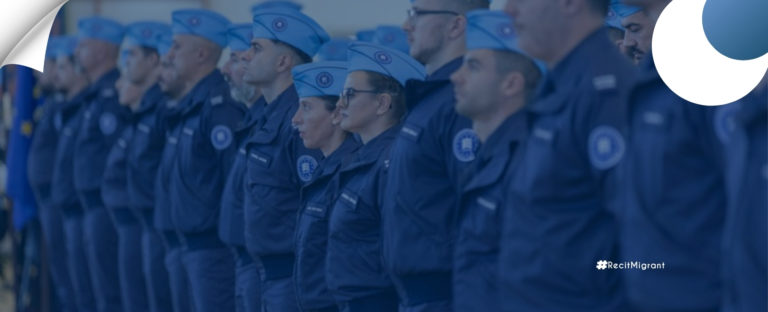
The sharpest change came with the 2019 regulation. The European Union handed Frontex unprecedented autonomy and created a “standing corps” aiming for 10,000 border guards by 2027. These officers wear the European uniform, may carry weapons and now command their own ships, aircraft and surveillance drones. The budget grew just as fast, from €6 million in 2005 to more than €800 million a year today. That rise shows how far securing borders has climbed up the agenda.
Shadow of illegal pushbacks
Under Fabrice Leggeri, the accusations of illegal pushbacks multiplied, notably in the Aegean Sea. Several journalistic investigations and oversight reports pointed to the agency’s role in operations that drove migrant boats back towards Turkish waters before the passengers could claim asylum. Such practices break international and European law.
For Sophie-Anne Bisiaux, of Alarm Phone Mediterranean, this case marks a turning point.
“To see justice finally take up these facts, even late, shows that pressure from civil society can crack this impunity. […] This case says that you can no longer hide behind that architecture [the outsourcing to third countries] to dodge accountability.” These pushbacks also expose a deliberate strategy, begun as early as 2016, of handing the responsibility for search and rescue (SAR) to the Libyan authorities (LCG) in order to maximise interceptions. Despite the European Court of Human Rights’ Hirsi Jamaa ruling, which brands Libya an unsafe zone, Italy and the EU set up ‘pushbacks by proxy’ through the Malta Declaration, to sidestep the international principle of non-refoulement. The mechanism turns actors that Europe itself trained into middlemen for a policy of detention. Under the cover of ‘managing flows’, it hands the violation of fundamental rights to a third State with no humanitarian guarantees.
The operational data also expose a systemic collusion between the official coast guard and criminal networks. The case of ‘Bija’ illustrates it: the UN sanctioned this trafficker, yet the European Union had trained him. Between 2017 and 2020, the authorities returned some 40,000 people to a territory where the UN still documents crimes against humanity, from slavery to torture. In short, the numbers confirm that the priority has shifted from rescue to border control at any price, and that it accepts the risk of deliberate shipwrecks and grave assaults on human dignity in order to hold down arrivals on European soil.
Aerial surveillance serving interceptions
“Frontex’s priority is not to save lives, but to make pushbacks to Libya easier…”
In the central Mediterranean, Frontex has shifted to an almost entirely aerial watch. By swapping ships for drones and aircraft (the Eurosur system), the agency dodges the legal duty to land rescued people in a safe European port. These assets mainly spot the boats leaving Libya and pass their coordinates to the Libyan coast guard.
The consequences are documented. The authorities send intercepted migrants straight back to the coasts they fled, to be locked up in detention centres ruled by violence and torture. Sophie-Anne Bisiaux underlines what this shift means.
“Frontex’s priority is not to save lives, but to make pushbacks to Libya easier. The aircraft and the drones serve above all to spot the boats […] in order to organise the pushback. […] This militarisation of the Mediterranean is what makes the crossing more and more dangerous,” she says.
Human toll that keeps rising
Since 2014, the International Organisation for Migration (IOM) estimates that more than 30,000 people have died in the Mediterranean. Even this figure counts as low, since it leaves out the ‘invisible shipwrecks’, the boats that vanish without a trace. Turning the Mediterranean into a zone of military surveillance has not cut the death toll; it has made the routes more dangerous.
The detention centres in Libya, where Frontex data help send people back, hold an alarming reality. The testimonies gathered speak of extortion, forced labour, rape and systematic torture. Sophie-Anne Bisiaux stresses that European authorities know all this.
“The people sent back to Libya often end up locked in detention centres where human-rights violations are massive. […] European officials keep making these pushbacks easier, and they do so in full knowledge of the facts!” she says.
Leggeri’s resignation and move into politics
In 2022, Fabrice Leggeri resigned as Executive Director after a damning report by the European Anti-Fraud Office (OLAF). The report pointed to poor internal management and the deliberate concealment of evidence tied to violations of fundamental rights. Soon after he left, the former senior official joined the Rassemblement National (National Rally), a move some observers read as the logical end of a career devoted to closing borders.
For human-rights campaigners, that political turn lifts the veil on the supposed neutrality of technocratic border management. According to Sophie-Anne Bisiaux, this “affiliation with the most extreme right […] is the sad illustration of the continuity between the so-called ‘technocratic management of borders’ that the agency hides behind and an openly avowed political commitment, one that calls for the total closure of borders.”
Why this trial matters
The investigation now under way in France concerns grave facts. It probes the personal responsibility of decision-makers inside a complex European architecture. The New Pact on Migration and Asylum, adopted in 2024, promises tougher biometric screening and even more outsourcing of controls to countries such as Tunisia and Mauritania. Against that backdrop, the outcome of the Leggeri inquiry could redraw the limits of what European agencies may do.
Should the investigation lead to a trial, it would send survivors and the families of the missing a message of institutional recognition. Initiatives such as the ‘CommémorActions’ have spent years trying to break the silence around deaths at sea. Sophie-Anne Bisiaux closes on what such a step would mean.
“A trial would mean that these deaths are not ignored, and that a space finally opens for families to demand truth and justice, by recognising the direct responsibility of European policies in the graveyard the Mediterranean has become.”
Justice must now decide whether Europe secured its borders at the price of active complicity with regimes and practices that assault the very humanity of those in exile.