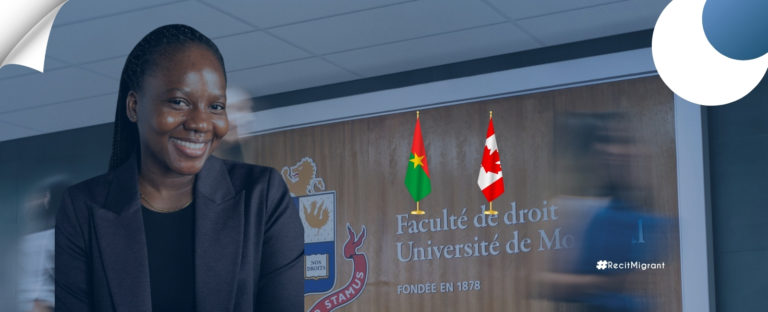
From Burkina Faso to Canada, Wend-Nèyellé Flora Inès Zongo is carving out a journey that commands admiration. A master’s student in business law at the University of Montreal, she pairs academic excellence with civic commitment. She volunteers with organisations such as Amnesty International and Welcome Notre-Dame-de-Grâce, and she belongs to the Institut du Nouveau Monde.
That steady commitment keeps her close to social realities while she works to advance human rights, inclusion and civic participation. In April 2026, the Supreme Court of Canada recognised her work with the prestigious Chief Justice Richard Wagner Prize.
The award honours young leaders who serve their communities, particularly in justice and access to the law. For Inès Zongo, it continues the work she has done with Pro Bono Students Canada, University of Montreal chapter.
Her efforts on access to justice made her stand out. The recognition reaches beyond her home country and shines a light on an engaged, ambitious African youth.
Between academic challenges and cultural adjustment
Flora Zongo holds a bachelor’s degree in Public Law and a master’s in Business Law and Taxation from Burkina Faso, and she has now studied in Canada for 18 months. Her time there has not been easy.
Before she left Ouagadougou, immigration delays created administrative hurdles and set her academic year back by two months. Once in Canada, she met the demands of a different education system, one that expects rigour, independence and critical thinking.
Distance from family added to the challenge. “I had to build real mental strength,” she confides, recalling the homesickness and the adjustment to a new life. Managing academic pressure while settling into a new society and culture proved another major hurdle.
Culture shock marked her Canadian experience too. New habits, new ways of communicating, new points of reference: everything changed.
The climate tested her as well. Moving from temperatures that often top 30°C in Burkina Faso to Canadian winters of -20°C demands quick adaptation.
Through it all, she has gradually made the new environment her own and turned these challenges into lessons.
Determined, Flora Zongo holds big ambitions. She plans a career in business law, with a particular interest in international investment and economic development.
Her goal is to work where law, economics and investment meet, and to contribute to high-impact projects, especially in Africa. For her, the law is not just a set of rules; it is a lever for social change.
Read also: Pélagie Nabolé’s fight to reconnect with her culture
Between expectations, realities and lessons
Before she left, Inès Zongo held a picture of migration that turned out richer and more complex than she expected. The paperwork did not surprise her; the culture shock did.
On a human level, the experience has exceeded her hopes. Despite the distance from her family, she has learned independence and responsibility. “Over time, I’ve built a family here,” she confides.
Through encounters, friendships and cultural exchange, migration has become for her a space of sharing and personal growth.
Living between two cultures is not always easy. But for Flora Zongo, this duality is a “strength”.
“I don’t see this dual belonging as a contradiction, but as a complement,” she says. Between openness to the world and loyalty to her roots, she is building a rich sense of who she is.
Far from the negative talk, Flora Zongo defends a constructive view of migration. Handled well, she says, it offers a major opportunity.
For the individual, it opens the door to quality training, new skills and the open-mindedness that a globalised world demands.
For countries of origin, it drives the transfer of skills, investment and the diaspora’s engagement in development.
Diaspora, lever for development
She warns, though, against the brain drain. She argues for a circulation of talent, so that skills gained abroad also benefit home countries.
To get there, she calls for a proactive, inclusive and structured approach, one that can turn the diaspora into a genuine strategic lever for African states.
“Migration, when we think it through, can become a powerful engine of development, for the individual and for the collective,” she concludes.