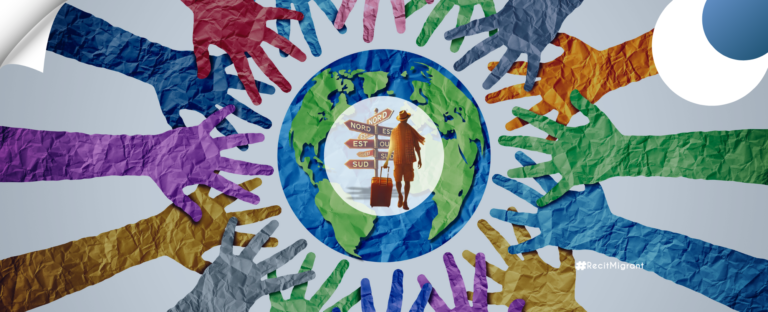
Globalization has profoundly altered the way people work, study, consume, communicate and travel. The internet now makes it easier to find out about job opportunities thousands of kilometres away; social media brings diasporas closer to their communities of origin; improved transport facilitates international travel; and economic exchanges are forging ever-closer links between regions. Against this backdrop, one question keeps coming up: does globalisation encourage migration?
The answer depends. Globalisation does indeed help to facilitate the movement of people and broaden the scope for migration. It makes certain destinations more accessible, enables information to spread rapidly and strengthens transnational networks. However, it is not, in itself, the sole driver of migration. Income disparities, employment opportunities, education, family reunification, conflicts, persecution, environmental disasters and demographic changes continue to play a decisive role.
Contemporary migration is therefore less the outcome of a single cause than the result of the interaction between economic, social, political, demographic, technological and environmental factors.
A Stocktaking of Increasing International Mobility
The figures provide an overview of the scale of the phenomenon. According to United Nations estimates, in 2024 304 million people were living in a country other than the one in which they were born, nearly double the 154 million recorded in 1990. International migrants then accounted for around 3.7 per cent of the world’s population, women making up approximately 48 per cent of this migrant population.
These figures should, however, be interpreted with caution. They primarily reflect the stock of international migrants – that is, people residing in a country other than their country of birth – rather than the number of people who migrated during a given year. They do not, therefore, mean that 304 million people crossed a border in 2024.
Above all, despite the growth in international mobility, international migration still represents a small proportion of the global population. IOM points out in its State of the World’s Migration Report 2026 that cross-border movements remain the exception rather than the norm: the majority of people continue to live in their country of birth, and internal migration is far more common.
In other words, it would be misleading to speak of a widespread ‘explosion’ in international migration. While the phenomenon is on the rise, it remains concentrated amongst a specific segment of the global population.
Not All Migrants Choose Europe or North America
One of the key lessons from international data is that migration is not simply a movement from poor countries to rich ones. Migration largely takes place within the same regions. In Africa, for example, IOM has estimated that in 2020 around 21 million Africans were living in another African country, compared with more than 19.5 million living in another region of the world. Intra-African migration has increased significantly since 2000.
Read this article: Why do more than half of Togolese people want to leave the country? | Dialogue Migration
This context is important for comprehending the dynamics of African migration. A Togolese person may travel to Ghana, Côte d’Ivoire or Benin to work or start a business; a Nigerian may settle in Ghana; a Malian may move to Côte d’Ivoire; a Senegalese person may move to another country in the region. Such movements may be temporary, circular or permanent.
Europe, North America and other regions also continue to be major destinations. However, they represent only part of the global migration system.
IOM thus emphasises the growing complexity of regional dynamics: countries can serve as countries of origin, transit and destination simultaneously. The once very clear-cut distinctions between ‘countries of emigration’ and ‘countries of immigration’ are becoming increasingly at odds with reality.
A Growing Diversity of Reasons for Migration
Why do people move? There is no single reason. Employment remains a major driver of international migration, and migrant workers constitute the largest group among international migrants. But migration patterns are becoming increasingly diversified.
Work, Search for Better Opportunities
Wage gaps, career prospects and the search for better living conditions remain key drivers. A person may leave their country because they cannot find a suitable job matching their qualifications, because their chosen sector offers limited opportunities, or because another economy is specifically looking for their skills. This mobility applies equally to low-skilled workers and highly qualified professionals: engineers, doctors, teachers, IT specialists, researchers, entrepreneurs and workers in the service industries.
The globalisation of labour markets further strengthens this dynamic by better aligning the supply and demand for skills on an international scale.
Education
Student mobility is also an essential component of global migration. Students leave their home countries to access programs that do not exist or are difficult to access locally, to pursue a specialisation, to improve their language skills, or to benefit from a particular academic environment.
However, student mobility can also become a first step towards establishing a career. After completing their studies, some graduated students choose to seek employment in their host country, whilst others decide to return to their home country or move between several different regions.
Families and Social Networks
Migration is also facilitated by family and community networks. When a person settles abroad, they can help other family members to join them by providing information, temporary accommodation, advice or financial support.
Diaspora communities thus become the social infrastructure of mobility. This aspect helps us understand why migration can continue even when economic conditions or migration policies change. A destination is not chosen solely for the job opportunities it offers: it may be chosen because a brother, sister, spouse, friend or community has already settled there.
Globalisation Making Information on Migration More Accessible
A few decades ago, finding out about opportunities for work, study or settling in a foreign country often required going through middlemen, agencies or relatives who had already travelled there.
Today, anyone can visit university websites, access job vacancies, visa procedures, community groups and migrants’ testimonials in a matter of minutes.
As a result, social media has created a digital space for migration. IOM had already demonstrated that breakthroughs in transport systems and telecommunications had profoundly transformed transnational connectivity and the way in which people get information and move around. Digital technologies enable migrants and prospective migrants, in particular, to maintain relationships with several countries at the same time.
However, this development comes with a contradiction. Information facilitates mobility, but disinformation can also fuel it or make it dangerous.
A video showing a migrant’s successful journey may present a very limited account of reality. Influencers may portray a destination as easily accessible, downplay living conditions or spread false information about visas and employment.
Digital globalisation therefore does not merely create more information; it also creates a greater need for reliable information on migration.
More Accessible Transport, Yet Borders Still Exist
The improvement of transport infrastructure has also resulted in a shorter travel time between regions. Aeroplanes, overseas buses, trains, ships and road networks now make it possible to travel quickly over distances that would once have taken several days, or even several weeks.
The increasing number of air and land routes has thus facilitated mobility for work, tourism, study and family visits. But the globalisation of transport has not resulted in the disappearance of borders.
On the contrary, one of the ironies of contemporary globalisation is that goods, capital and information can sometimes move more easily than people. Goods cross international borders on a daily basis, whilst a worker may be required to meet stringent visa, work permit or residence permit requirements.
Thus, being connected to the world does not necessarily mean having the ability to move freely within it.
Does the Globalisation of Lifestyles Influence Migration Plans?
Globalisation does not merely revolutionise the ways in which people migrate. It also reshapes perceptions of life elsewhere. Daily exposure to foreign lifestyles comes through films, TV series, digital platforms, social media, advertising and international exchanges.
This cultural exchange may fuel the desire to study at a foreign university, work for an international company, encounter a different society or pursue a higher standard of living.
However, it can also trigger the opposite reaction. Globalisation does not necessarily mean the uniform adoption of the Western model of consumption. It can also prompt people to seek alternative lifestyles with some individuals looking elsewhere for a different social, political, cultural or environmental context.
Mobility can therefore be driven just as much by the appeal of a particular lifestyle as by the desire to move away from it. Nevertheless, we must avoid an oversimplified interpretation: simply seeing a different standard of living on the internet is not enough to explain migration. Aspirations generally need to be coupled with concrete factors including financial resources, networks, skills, opportunities, family circumstances, migration policies or security conditions.
A Form of Globalization That Produces Both Mobility and Immobility
Globalization therefore seems to create a dilemma. On the one hand, individuals have greater access to ways of learning about the world, communicating with people abroad, organising travel and maintaining cross-border relationships. On the other, the actual opportunities for mobility are still highly inconsistent. A student with a scholarship and a passport allowing for simplified entry does not face the same constraints as a worker without resources wishing to enter the same country.
Visa policies, travel costs, conditions for accessing the labour market, the skills required and opportunities for regularisation have a major impact on who can actually turn their plans for mobility into migration. Globalisation therefore broadens the horizon of possibilities without necessarily democratising access to mobility.
Increasingly Complex Flows
The other major shift affects the nature of migration pathways. The traditional approach often envisaged a linear migration process: departure, arrival, settlement.
Contemporary migration pathways are sometimes far more complex involving departure to a neighbouring country, a temporary stay there, a return home, a new move, studying in a third country, working elsewhere, and then possibly returning home.
Migration can become circular, temporary, repeated or transnational. IOM data on migration routes clearly show the importance of an approach that considers not only the country of departure and the country of destination, but the entire itinerary, with its various stages, stakeholders and risks.
This trend is particularly noticeable in African migration patterns, where regional, commercial, family and work-related movements are combined with migration to other continents.
Then Does It Accelerate Migration?
Yes, but it does not, on its own, explain it. Globalisation serves as both an accelerator and a catalyst for opportunities. It fosters connections between regions, improves transport, facilitates the rapid dissemination of information, develops transnational networks and brings labour markets closer together.
However, it does not remove the traditional causes of migration or borders. Economic disparities, labour needs, education, family reunification, conflicts, persecution, demographic changes and environmental factors continue to shape decisions and migration patterns.
Moreover, globalisation can simultaneously lead to greater mobility and greater control over mobility. The paradox is therefore not so much that of a world where everyone could move freely, but rather that of a world where opportunities for movement have expanded considerably, whilst access to them remains profoundly unequal.
The contemporary migration issue is therefore not merely a matter of knowing how many people migrate, but also of understanding who can migrate, why, by what routes, to what destinations, under which conditions, and with what prospects for return or settlement.
It is exactly this diversity that makes migration one of the most visible indicators of the economic, social, technological, demographic and geopolitical transformations of the contemporary world.