
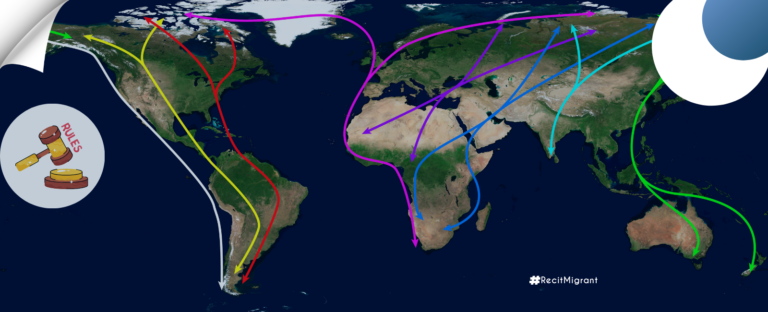
Migration, immigration, emigration and migrants. These terms are now central to public and media debate. However, the international migration law that governs these widely discussed human realities remains largely unknown to the general public. This fact sheet sheds light on this essential concept, its foundations and principles, and the people it affects.
According to the Migration Glossary, international migration law encompasses all international legal rules applicable to migration phenomena. The Centre for Human Rights Research (CRDH) builds on this definition, stating that it includes all legal rules derived from international treaties, customary norms or laws and general legal principles that govern the movement of people between States. The purpose of this body of law is to organise the management of migration and guarantee the protection of migrants’ fundamental rights, providing a framework that goes beyond national legislation alone.
As Avocat Droit International highlights, international migration law encompasses rules relating to entry into a State’s territory, residence, integration, the protection of human rights, security, and international cooperation between States. According to the same source, several terms are often used to refer to similar or complementary concepts, including international migration law, international refugee law, international alien law, international displaced persons law, international mobility legislation, international immigration regulations, migrant protection legislation, and international migration standards.
This legal framework covers various categories of people on the move. It applies to anyone who leaves their country of origin, whether voluntarily or involuntarily, for reasons including economic circumstances, family matters, environmental factors or security concerns. These categories include migrants, refugees, asylum seekers, migrant workers and stateless persons.
International migration law is based on a variety of national and international legal sources. Key parts of this legal framework include international treaties such as the 1951 Convention relating to the Status of Refugees and its 1967 Protocol, and the 1990 International Convention on the Protection of the Rights of All Migrant Workers and Members of Their Families. According to Avocat Droit International, there are also international protocols against the trafficking and smuggling of migrants, setting out specific obligations that states have agreed to uphold.
Customary international law is another important source. As Wikipedia explains, these are rules recognised as legally binding even by States that have not formally acceded to a treaty. One example is the principle of non-refoulement.
General principles of law complement this framework. The CRDH emphasises the principles of non-discrimination, respect for human dignity, international cooperation, and State sovereignty while ensuring the protection of fundamental rights.
These principles form the basis of several fundamental principles of international migration law. For example, the principle of non-discrimination states that all migrants should be treated equally regardless of their race, religion, nationality or gender, in line with the standards set out in the CRDH. Wikipedia also highlights the principle of non-refoulement, which prohibits the expulsion of individuals to countries where their life or freedom would be at risk. This principle is enshrined in the 1951 Refugee Convention and recognised as a customary rule of law in international law.
International law recognises the right to leave any country, including one’s own. However, as Oxford Academic points out, entry into another country is subject to its sovereignty and access conditions. Another fundamental principle is respect for human dignity and human rights. According to the United Nations, these rights must be guaranteed to all migrants, regardless of their legal status.
Finally, Wikipedia states that the principle of international cooperation and solidarity requires States to collaborate in effectively managing migration, tackling irregular migration, and protecting the most vulnerable.
In summary:
| Issue | Definition/Requirement |
| Subject | International rules of law governing migration between States. |
| Sources/Conditions | Treaties, customary international law, general principles of law and international agreements. |
| Principles | Non-discrimination, non-refoulement, respect for human rights and international cooperation. |
| Persons concerned | Migrants, refugees, asylum seekers, migrant workers and stateless persons. |