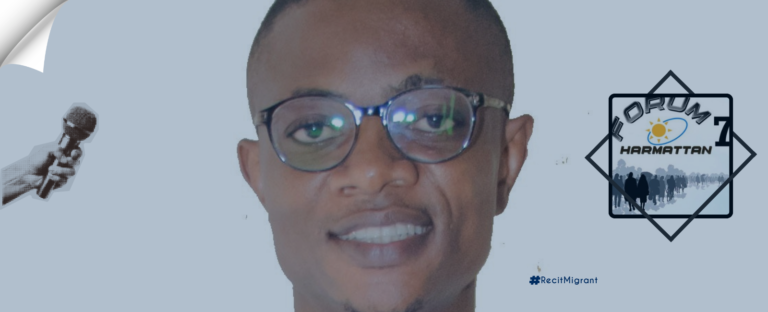
With the seventh Harmattan Forum approaching, scheduled to take place from 18 to 20 February 2026 in Lomé, we spoke to Dieudonné Kossi, the Executive Director of Clinique d’Expertise Juridique et Sociale (CEJUS) – the organisation behind this significant event focusing on migration issues and contemporary crisis governance. In this interview, Mr Kossi reflects on the objectives of the forum, its strategic challenges and his expectations for the next edition.
Dialogue-Migration: Could you briefly introduce us to the Harmattan Forum and explain why it is important in discussions revolving around migration in Africa?
The Harmattan Forum is a flagship initiative of CEJUS. Over the course of seven editions, it has established itself as a credible platform for reflection, dialogue and policy-oriented proposals on migration. It is not merely an academic gathering; it is a space for raising awareness and encouraging collective reflection on the role of human mobility in contemporary African societies.
The Forum was born out of a determination to move beyond alarmist narratives and to put people back at the heart of the debate. It brings together researchers, policymakers, civil society actors and young people to jointly develop concrete, dignified and inclusive responses to migration challenges. Ultimately, the Harmattan Forum seeks to reshape perceptions of migration based on African realities while amplifying the voices of those who advocate for human dignity and social justice.
The Forum is now in its seventh edition. What makes this edition different from previous ones?
Each edition has represented a step towards greater maturity, but this one marks a genuine turning point. For the first time, migration is at the heart of the governance of contemporary crises, whether they are climate-related, economic or security-related. Human mobility is inextricably linked to these global challenges, hence the ambition of this edition to move beyond diagnosis and offer concrete policy recommendations that prioritise inclusion as a driver of sustainable development and peace.
This edition also introduces the Forum Village: a dynamic, interactive space designed as a migration-focused fair where grassroots initiatives, innovative practices and citizen exchanges converge around a highly relevant theme. The Forum also stands out for the diversity of its international speakers and the significant mobilisation of stakeholders. As the Forum’s institutional sponsor, the University of Lomé plays a key role by providing collective support for this initiative.
Why was the theme ‘Migration at the heart of global governance of contemporary crises: making inclusion a lever for sustainable development’ chosen?
The time when migration could be treated as a marginal issue is long gone. Today, human mobility is deeply intertwined with the major challenges facing our world, such as climate change, economic crises, conflict and the aspirations of young people. This reality demands a form of governance that recognises migration as a structural component of our societies, not an isolated problem.
Making inclusion a lever for sustainable development means recognising that every migrant is first and foremost a human being with potential. It also means acknowledging that every woman and every young person has something valuable to contribute, provided they are given the opportunity to participate, express themselves and be fully included in social, economic and political life.
How does migration present both challenges and opportunities for sustainable development in Africa?
Migration becomes a challenge when it is driven by structural vulnerabilities such as poverty, limited economic opportunities, climate shocks and armed conflict. Under these conditions, it often exposes people to serious risks and can endanger lives.
At the same time, however, migration also represents a powerful opportunity. It reflects the dynamism of African societies and the capacity of their populations to adapt, innovate and contribute, both in destination countries and in their communities of origin. Supported by appropriate public policies, legal protection frameworks and inclusive development strategies — migration can serve as a catalyst for job creation, local capacity building and richer cultural and economic exchanges.
What are the main migration challenges that this forum is aiming to address?
Firstly, the Forum seeks to raise awareness of the urgent need to protect migrants’ rights in all contexts, and to ensure safe migration routes. A second priority is tackling illicit trafficking and the exploitation of migrants. We will also focus on socio-economic integration challenges and creating local opportunities to reduce forced migration. Finally, the Forum will examine issues related to inclusive border governance and migration policymaking. Overall, our objective is to take a comprehensive, humane and pragmatic approach to migration dynamics, which affect us all.
What concrete results do you expect to emerge from the discussions and recommendations of this forum?
We hope that the Forum will turn reflection into action by inspiring more appropriate public policies, stronger institutional commitments, renewed cooperation programmes and greater local community ownership of migration issues. The recommendations are intended to form the basis of practical initiatives that promote integration, protect migrants’ rights and encourage social innovation. Ultimately, we aim to turn these ideas into concrete policies, actionable projects and measurable commitments that are implemented on the ground.
Who is this forum targeted at? Researchers, decision-makers, young people or civil society?
The forum is deliberately inclusive and open to everyone: researchers, public decision-makers, civil society, international actors and young people, who will ultimately inhabit the world we are shaping today. No group is secondary in this dialogue. In fact, the diversity of perspectives strengthens our proposals and helps us to generate more comprehensive, equitable and forward-looking solutions.
What role should young people play in discussions on migration and crisis governance?
Young people are at the heart of these discussions because they are the group most affected by them, yet also the most hopeful for the future. Young Africans do not migrate solely out of necessity; they are also driven by a desire to learn, innovate and create new opportunities.
They should therefore not merely be seen as objects of public policy, but as active contributors to the search for solutions. Their energy, ideas and creativity are vital for rethinking development models that associate mobility with opportunity and empowerment rather than vulnerability.
What is CEJUS’ plan for turning the ideas generated by the Forum into practical action?
At CEJUS, we combine reflection, legal research and social intervention in our approach. The discussions at the Harmattan Forum do not end with the event itself. The Forum’s proceedings will be edited, published and disseminated widely to capture the analyses, recommendations and best practices that emerge from the debates. Our goal is to make this knowledge accessible to decision-makers, practitioners, young people, and the communities most affected.
These outputs will then feed directly into our projects, advocacy efforts, and partnerships with national and international institutions. We are committed to turning the Forum’s recommendations into practical programmes focusing on education, raising awareness, providing legal support, and encouraging citizen participation. In other words, we are not just talking about migration; we are taking concrete action to transform realities.
What message would you like to convey to policymakers and international partners at the close of this forum?
Put simply, migration is no longer a peripheral issue; it is central to peace, security and sustainable development. We need humane, rights-based policies that create opportunities for our populations, protect the most vulnerable and recognise the contributions of migrants.
CEJUS calls on all people of goodwill to engage with this agenda. The Harmattan Forum is an open, inclusive, and collaborative platform, and we welcome support, partnerships, and collaborations of all kinds, be they institutional, academic, technical, or civic. Ultimately, our commitment will be measured by the concrete actions we take together, here in Africa and across the world.’
What message would you like to share with people interested in migration issues? This could be members of the public or stakeholders.
I would like to warmly invite everyone to share their ideas, experiences and aspirations at the Harmattan Forum. Migration is not a temporary crisis; it is a profound human reality. We need your engagement to help shape a vision that protects, includes and transforms. This dialogue, which commences in Lomé on 18, 19 and 20 February 2026, will determine the future we share.
Now in its seventh year, the Harmattan Forum aims to foster dialogue between national and international stakeholders, and promote inclusive solutions to contemporary migration challenges. This is an exceptional opportunity to come together and explore sustainable solutions for the future.