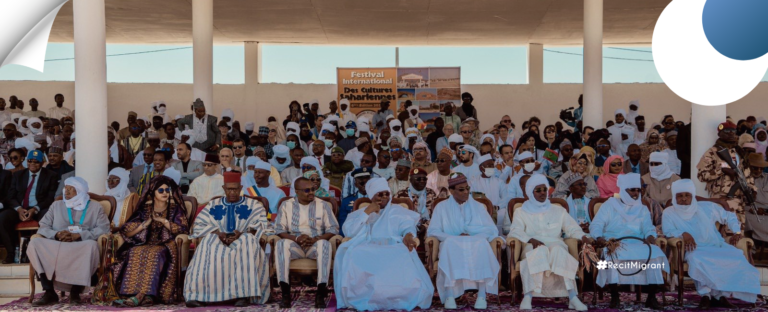
The sixth edition of the Festival international des cultures sahariennes (FISCA) – International Festival of Saharan Cultures (FISCA), took place in Amdjarass from 7 to 13 February 2026. Amdjarass is the capital of the Ennedi-Est province in Chad. The festival brought together delegations from Africa, Europe and Asia to explore the theme of ‘South–South cooperation: culture and sustainable tourism for inclusive territories’. As well as its cultural dimension, the event offered an unexpected perspective on Saharan mobility.
FISCA sheds light on movements that do not fit into the usual categories associated with the Sahara. Participants do not cross the desert to flee conflict or avoid crossing a border. They travel to exhibit, exchange ideas, debate and create. This organised, supervised mobility challenges the dominant images associated with irregular migration routes.
The attendance of Rimtalba Jean Emmanuel Ouédraogo, Prime Minister of Burkina Faso, Ali Mahaman Lamine Zeine, Prime Minister of Niger, and Mamou Daffé, Mali’s Minister of Handicrafts, Culture, Hospitality Industry and Tourism, gave the festival a clear political dimension. In their speeches, they emphasised the importance of regional cooperation and shared heritage, as well as the role of culture in fostering stronger ties within the Sahel region. This level of governmental involvement demonstrates that cultural exchanges are recognised as a diplomatic tool in a region which is often only considered in terms of security.
The Sahara is often portrayed as merely a transit zone to Europe, a backdrop for human trafficking and tragedy. However, this obscures the desert’s longer and more complex reality. Historically, the terrain has facilitated commercial, religious and intellectual exchanges between sub-Saharan Africa, the Maghreb, and the Mediterranean world. Amdjarass is part of this ongoing legacy.
The Sahara is a crossroads, not a border
South–South cooperation highlights the fact that not all migration from Africa goes northwards. Contemporary migration patterns are characterised by mobility within the Sahel, collaborations between Maghrebi and West African artists, and broader regional cultural interactions. However, these dynamics are largely absent from public discourse, which is often dominated by narratives focused on migration control policies. The presence of guests from Europe and Asia further supports this perspective. These movements are rooted in cultural cooperation and territorial development, reflecting mobility driven by mutual recognition and networking rather than coercion.
Adopting a FICSA perspective on migration does not mean ignoring the challenging circumstances that people encounter in the Sahara. Migration routes exist and continue to result in tragedies. However, focusing solely on these distressing routes obscures the diversity of human movement across the region.
Amdjarass reminds us that mobility can be associated with creativity, knowledge sharing and regional cooperation. In an area often associated with departure and exile, the festival offers an alternative narrative, showcasing a Sahara that unites rather than divides.