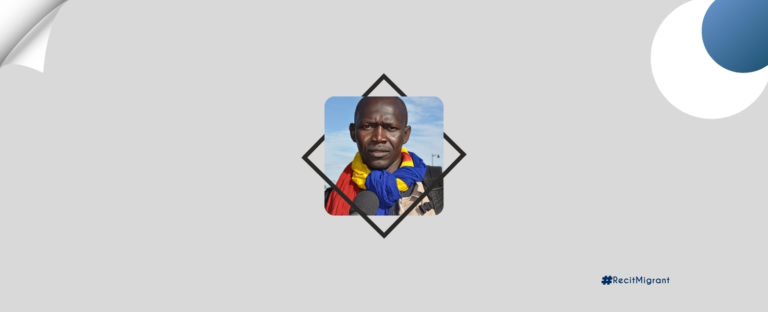
The man is involved in countless endeavours. His life has never been smooth sailing. From Chad to France, via Tunisia, Senegal and Guinea-Conakry, human rights defender Makaila N’guebla has suffered a real ordeal.
Hunted by the N’Djamena regime for over a decade, expelled from Tunisia and Senegal, and finally welcomed in Guinea before finding refuge in France, Makaila embodies the unrelenting struggle for justice and equality. His voice both unsettles and deprives the Chadian leader of sleep. Against all expectations, the head of State stripped Makaila of his nationality. Reduced to statelessness as a result of his struggle, the Chadian activist reflects on the endless trials of a life marked by forced exile.
Path of a tireless activist
Makaila N’guebla is a name that resonates in Chad as a symbol of resistance to injustice and the fight for human rights. First targeted by the late President Idriss Déby and later his son, Mahamat Idriss Déby, his confrontation with the Déby regime began while he was a student in Tunisia.
This was in 2000. Studying Commercial Administration at the Tunisian-Canadian Centre on the outskirts of Tunis, he was also passionate about journalism and wrote articles for the weekly magazine Jeune Afrique, denouncing the socio-political situation in Chad. From Tunisia, his adopted country, he regularly criticised the authoritarian excesses of Idriss Déby’s regime, electoral fraud and violations of human rights and civil liberties.
This did not sit well with N’Djamena. The young student soon became a target of the Chadian authorities, who requested that the regime of Tunisia’s Ben Ali expel him to Chad, where his fate had already been sealed. He was arrested on 5 May 2005 and detained in a police station in Tunis.
Manhunt and expulsions
He recounts sadly that it took the intervention of a French friend, Anne Picquart, and the Tunisian League for Human Rights (LTDH) to prevent his extradition to Chad. To spare him the grim fate that awaited him, Senegal issued him an entry visa through its embassy in Tunis. After spending four days in a Tunisian detention centre, he flew to Dakar on 10 May 2005, where he applied for political asylum, which was denied.
This marked the beginning of another turbulent chapter. In 2013, history repeated itself. Chad dispatched its Minister of Justice at the time, Jean Bernard Padaré, to demand his expulsion from President Macky Sall. He was accused of inciting Chadians to launch a popular uprising inspired by the Arab Spring movements that had toppled authoritarian regimes such as those of Zine El-Abidine Ben Ali, Hosni Mubarak and Muammar Gaddafi.
He was arrested by the Senegalese police on 7 May 2013. He was questioned by the Directorate of Territorial Surveillance (DST) from 9 a.m. to 3 p.m., after which he was taken to his home. He was then brought back to a police station in Dakar, where he was detained from 3 p.m. to 7 p.m. He was then taken directly to the airport and expelled to Conakry during the night of 7–8 May 2013.
“I owe my life to the widespread mobilisation of Senegalese, African and international NGOs, as well as the support of journalists, French politicians and researchers, who intervened on a large scale to prevent my extradition to Chad, where my life was in danger,” the activist recounts. It was in this context that France stepped in, granting him asylum through its embassy in Conakry.
Return to Chad… then rupture once again
A period of relative calm followed and then history repeated itself. Thanks to an outstretched hand from transitional President Mahamat Idriss Déby Itno, Makaila and three of his comrades agreed to return to Chad. Makaila was subsequently appointed an Adviser on Special Assignment and later Human Rights Adviser to the President — a role consistent with his long-standing commitment to social justice.
It appeared to be the perfect resolution – yesterday’s enemies had become today’s allies. Many believed that this marked a thaw in the perpetually tense relationship between activists and those in power. For at least twenty months, everything seemed to be going well.
Then came a proposal that the blogger found unacceptable. The President’s Office suggested he join the National Council of Salvation (CNS), which is a parliamentary body of the ruling party, the Patriotic Salvation Movement (MPS). He refused outright. This was exacerbated by a disagreement with Mahamat Ahmat Alhabo, the current Secretary-General of the Presidency.
Feeling pushed to the brink, he was dismissed from his duties and once again took the path of exile, returning to France, where his wife and children lived. He picked up his pen yet again to do what he does best: defend human rights and demand justice for all.
Controversial stripping of nationality
Following Mahamat Idriss Déby Itno’s rise to the presidency, the Chadian regime hardened its stance. The government has tightened restrictions on civic and political freedoms, carried out the extrajudicial killing of party leaders such as Yaya Dillo, arrested prominent figures like former Prime Minister Succès Masra and sentenced him to twenty years in prison, forced journalists and civil society activists into exile and dissolved organisations through repressive measures.
Against this backdrop of silencing dissenting voices, Makaila and Charfadine, who are journalists and activists residing in France, had their nationality revoked by presidential decree on 17 September 2025. Makaila considers this measure to be part of a strategic set of actions by the government against any perceived hostility. Paradoxically, he adds, it has strengthened his credibility and determination to continue fighting the injustices suffered by Chadians.
Nevertheless, he regrets his status as a stateless person and has appealed to both the UN Human Rights Committee and the African Commission on Human and Peoples’ Rights to register his objection. According to the 1954 Convention Relating to the Status of Stateless Persons, a stateless person is defined as someone whom no State considers a national under the operation of its laws.
Legal analysis and reactions
According to Dr Evariste Djimasdé, a Human Rights and International Criminal Justice specialist, if these two individuals have no other nationality and the revocation is enforced, they could be legally considered stateless. However, he adds a caveat: revocation resulting in statelessness is, in principle, prohibited except in extremely limited, clearly regulated and justified cases.
The presidential decree ordering the revocation has sparked strong reactions. The stated reason is alleged collusion with foreign powers and activities deemed incompatible with Chadian citizenship. Tribune Echos points out that Chadian nationality is governed by the 2024 Constitution, the Nationality Code (Law No. 33 of 23 December 1962 and subsequent amendments) and international conventions ratified by Chad.
According to Article 56 of the Code, such a measure can only be justified by a serious threat to the interests of the State, such as espionage or collusion with the enemy. Even then, the law usually only applies to naturalised citizens, not Chadians by birth. Legally, the revocation process must follow due procedure: the individual must be informed and have the right to defend themselves. In some cases, the State Council must also be consulted.
However, the published decree makes no mention of these procedural safeguards, which raises questions about its legality. Both the Chadian Constitution and international conventions prohibit the creation of statelessness. If the individuals concerned hold no other nationality, revoking their citizenship would contravene Chad’s legal obligations.
Dr Evariste Djimasdé views this as a matter of legality and constitutionality rather than a political debate. There is no constitutional provision that explicitly grants the President the power to revoke the nationality of a Chadian citizen.
The expert outlines the applicable cases and conditions in which nationality is governed by the Constitution and Ordinance No. 33 of 14 August 1962. Article 27 provides for revocation in cases of fraud in naturalisation, conviction for crimes against internal security, employment by a foreign power after being ordered to resign, or engaging in activities that are incompatible with or detrimental to the State.
However, Presidential Decree No. 2300/PR/PM/MATD/2025 cites ‘collusion with foreign powers’ — a reason not explicitly provided for under Article 27.
This is only the second time in Chad’s history that such a measure has been taken. In 1960, Gabriel Lisette, who was of Guadeloupean origin and was then Vice-Prime Minister, was stripped of his nationality by Ngarta Tombalbaye.
According to the specialist, under current law, such unilateral revocation by the Executive is legally contestable and violates constitutional principles and international obligations. The risk of statelessness constitutes a serious breach of fundamental rights. There are legal remedies at both the national and international levels.
Rural Exodus, Irregular Migration and Exile: The only lifelines for Chadian youth
Rural exodus, irregular migration and exile have become the only viable options for Chadian youth. The former Human Rights Adviser views the large-scale departure of young people to other countries as a revealing symptom of Chad’s crisis: a generation disillusioned, desperate and disoriented by broken promises.
He describes the socio-political situation as bleak, stating that the country has become unlivable in the face of widespread exclusion and the massive impoverishment of large segments of the population left to fend for themselves.
Also read: “Sika: No young person leaves their country for fun… it’s a real tragedy.”