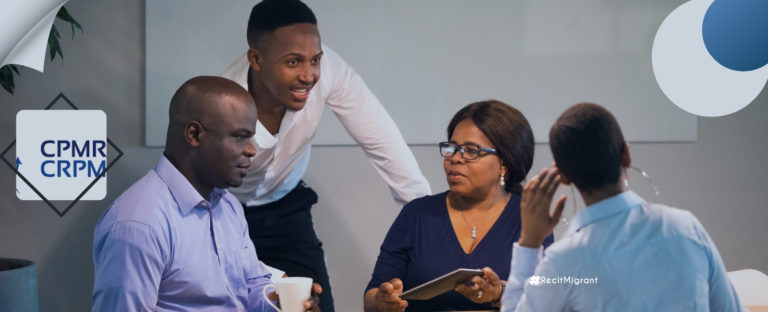
In mid-December, the Projet de Coopération Régionale en Matière de Politiques Migratoires – CRPM (Regional Cooperation Project on Migration Policies) launched its second phase, to strengthen national capacities in Cameroon, Comoros, Côte d’Ivoire, Guinea, Madagascar and Senegal. A regional study highlights the crucial challenges surrounding the reintegration of returning migrants.
On the eve of Senegal’s National Diaspora Day, which begins on 17 January, the Regional Cooperation Project on Migration Policies is offering a preview, focusing on returning migrants and their socio-economic reintegration. The second phase of the project is entering a concrete operational stage, aiming to build on the achievements of the first phase. The project targets six partner countries (Cameroon, Comoros, Côte d’Ivoire, Guinea, Madagascar and Senegal) and has three central objectives.
For Senegal, migration is much more than just a socio-economic reality; it is also a strategic tool for development. “The diaspora contributes to the development of their place of origin through community investments, skills transfer and decentralised cooperation, as well as remittance transfers,” emphasises the Secretary of State for Senegalese Abroad, Chérif Amadou Diouf.
This commitment is being celebrated for the first time with National Diaspora Day on 17 December, an event that highlights the strategic importance of this high-potential community. ‘Our government aims to promote inter-African cooperation by strengthening the role of the diaspora and initiatives for African integration. This is why the CRPM project fully aligns with the authorities’ orientations towards South–South cooperation actions,’ adds Mr Diouf.
The main focus of this phase is the presentation of a regional study by the Migration Policy Institute Europe (MPI). This study provides a thorough evaluation of the mechanisms that facilitate the reintegration of returning migrants. The study aims to identify best practices and the challenges encountered in order to formulate strategic recommendations. The findings emphasise the complexity of the return process, which is often overlooked in public policy, particularly in the case of spontaneous returns.
Bamadi Sanokho, the head of the CPRM 2 project, shared his perspective on the different types of return home: “Return is neither a simple administrative process nor an endpoint. It can be voluntary, forced, planned, endured, assisted or spontaneous.” He added that the study reveals “major psychosocial difficulties” which are still “very insufficiently taken into account, even though they determine the success of any economic reintegration”. Another major challenge identified is institutional fragmentation, with many actors operating without clear, sustainable and visible coordination for those affected.
Towards a new approach: dialogue, trust and operational effectiveness
According to CRPM officials, these findings are not criticisms, but rather a basis for clear-eyed and constructive dialogue. The project is based on the belief that “no country can address the complexity of migration challenges alone”.
The CRPM’s objective is to share experiences and adapt solutions.
For Senegal, the results of the study are expected to strengthen the Mécanisme National d’Orientation des Migrants de Retour (MNO) or National Referral Mechanism for Returning Migrants. Mobilising stakeholders has already led to the adoption of Standard Operating Procedures, demonstrating the country’s commitment to inclusive, coherent migration governance centred on respect for human rights. The two-day workshop programme will alternate between presentations, round tables and participatory workshops, with the clear ambition of ensuring that these exchanges generate practical and operational lessons for countries to improve their return and reintegration policies.