The 2025 Africa Cup of Nations in Nouakchott has attracted far more than just football fans. Over the course of several weeks, public match screenings have provided a platform for a social cohesion initiative led by the International Organisation for Migration (IOM) and the Mauritanian non-governmental organisation Innovation for Development, and supported by the European Union.
Screens were set up in the Riadh, El Mina and Arafat neighbourhoods for the CAN 2025 championship. Groups of young Mauritanians, with flags draped over their shoulders, shared laughter, post-match analysis and emotions with Senegalese, Malian, Guinean and Ivorian spectators, who were all gathered around the same screen. Singing, applause and tense silences during decisive moments reflected a shared passion that transcended national affiliations. During an AFCON match, differences fade in favour of a collective sense of belonging, with football acting as a unifying force and a common language for communities.
Messages promoting awareness of mutual respect, solidarity and peaceful coexistence, as well as highlighting the risks associated with irregular migration, were disseminated around sporting events. The campaign, entitled “Together”, was officially launched on 18 December and leveraged the popularity of football to foster dialogue in urban areas marked by high social and migratory diversity. Short videos and speeches shown during intervals reminded viewers of the importance of cohesion between communities.
Moussa Sidi Bagayoko, the former captain of the national football team and current coach of the Mauritanian beach soccer team, was among those involved and featured in one of the clips. In it, he emphasises the unifying role of sport and the importance of respect and cooperation as shared values. This initiative is taking place in a context of migration that is shaping Mauritania. According to the most recent national census, nearly 20% of the population – around 967,000 people – are internal migrants, primarily drawn to Nouakchott and the coast. The country also hosts around 142,000 foreign migrants, primarily young people, as well as over 309,000 refugees from neighbouring countries, according to the national authorities.
For the IOM, such dynamics make it crucial to take action to prevent tensions and strengthen social bonds. “Football enables us to engage with a broad and diverse audience in an informal setting,” explains Idrissa Somparé, IOM Chief of Mission in Mauritania. “It is an effective tool for encouraging dialogue between migrants and host communities.”
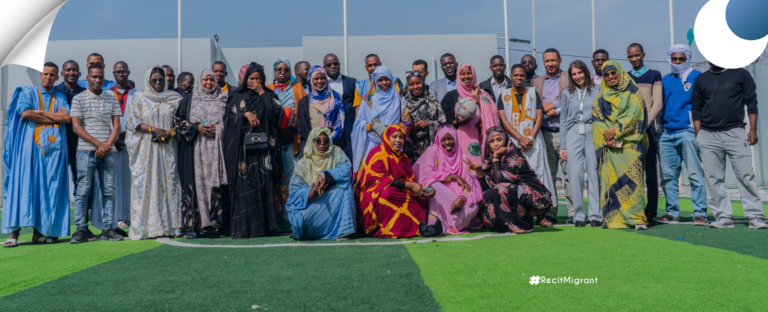
Beyond institutional messages, the screenings sparked informal discussions among participants. Discussion panels and debate sessions were organised to encourage people to speak up and share their experiences. Yacine Dibo, a member of the Union of Senegalese in Mauritania, notes that ‘football creates common ground that facilitates communication, even between people who do not usually interact with each other.’
The campaign targeted approximately 3,000 young Mauritanians and migrants. Throughout the event, information spots highlighting the dangers of irregular migration were broadcast alongside messages promoting social cohesion.
The initiative forms part of the Succeeding Together in Mauritania programme, which is implemented by the IOM and funded by the European Union. Following the conclusion of AFCON, the organisers emphasised that the event had presented an opportunity to experiment with using sport as a means of prevention, disseminating information, and fostering social cohesion within the context of intricate local migration dynamics.