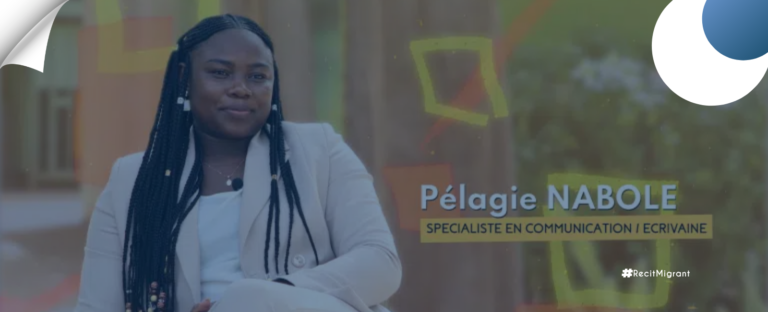
A figurehead for a generation of Africans on the move, Pélagie Nabolé lives between cultures and ambitions. Passionate about communication and deeply committed to literature, she made her name in Burkina Faso’s literary world very early. At just 16 she wrote her first novel, Le péril, published in 2012 while she was still in the early stages of her degree in organisational communication. That early debut was soon followed by a collection of short stories, Nos impossibles amours.
Her career has since taken on a new dimension. Now settled in France to continue her studies, she works as an international project manager on issues such as peace, gender equality and community resilience in Africa. Her life is one of extensive professional and personal travel across West and Central Africa and Europe. Nicknamed “Bangr-naaba” (“intellectual” in Mooré, one of the most widely spoken languages in Burkina Faso) by her family, she carries a dynamic outlook shaped by her many experiences.
What was meant to be a simple interview turned into a searching conversation. From the start, the young professional rejected the word “migration”, feeling it did not fit her situation. “I prefer to talk about mobility rather than migration,” she said. “My journey isn’t just about leaving. It’s about moving between different places and realities.”
The choice of words is far from trivial. It reflects a wish to move past the rigid stereotypes so often tied to migration, and to stress continuous movement and the interplay of territories and identities. That narrative sits squarely within the founding principle of Dialogue Migration.
Disillusioned by the day-to-day realities of life in France
Like many international students, she ran into practical hurdles when she arrived in France. Behind the dreams of opportunity lay a harsher reality: complex paperwork, trouble finding accommodation and the challenge of a different academic system.
“Finding accommodation wasn’t easy for foreigners,” she admits.
Far from her family and familiar surroundings, she had to adapt fast. That forced independence was also formative, demanding real effort and resilience.
The dark side of mobility, loneliness and emotional strain
Like many young Africans, she held an idealised picture of life abroad before she left, fed by tales of comfort and surface appearances.
Once there, she found reality more nuanced and, at times, harsher.
“We often imagine the comforts, but rarely the loneliness,” she points out.
Loneliness became one of the major trials of her journey. Distance from family and friends, emotional strain and fraying relationships can all wear down a person’s stability.
She draws attention to a subject still rarely discussed: the mental health of people living abroad.
“When loneliness becomes long-term, it can weigh heavily and lead to depression,” she warns.
Faced with this, she stresses the value of rebuilding connections, surrounding yourself with others, asking for help and leaning on communities or professionals.
Moving between cultures, at once enriching and demanding
Living across cultural spaces calls for constant adjustment. Pélagie Nabolé describes the sometimes fragile balance between worldviews.
“I navigate between different frames of reference, beliefs and perceptions that are taken as true here, but not elsewhere,” she explains.
That can breed a sense of being caught in between, of never quite belonging in either Africa or Europe. But it also opens the door to a rare richness.
Beyond the difficulties, this plurality becomes a space of freedom, a chance to explore, to choose, to bring things together and to build a hybrid identity.
“I’m no longer in a forced limbo, but in a free, hybrid space,” she asserts.
Identity and belonging, reconnecting with your roots from afar
Living abroad can reshape your sense of self. For Pélagie Nabolé, the experience deepened her bond with her roots and prompted her to reflect on who she is.
She points to a paradox often felt in diaspora communities, that people grasp who they are most clearly when they are away from home.
“Being elsewhere gave me an almost instinctive need to tell the story of my country,” she reveals.
That urge springs from her wish to offer a more nuanced picture of Africa, far from the clichés so often repeated.
Literature as an extension of experience
Her international life feeds directly into her writing and her projects. Living abroad has been both a source of inspiration and a spur to action.
With that in mind, she founded Éditions Arzeka, a publishing house devoted to educational innovation. Her aim is to create inclusive teaching materials for language learning, whether a mother tongue or an international language.
The ambitious project seeks to restore African languages to their rightful place in education and to nurture openness to the world.
“Our mother tongues must be springboards, not obstacles,” she insists.
Changing how we see African mobility
Pélagie Nabolé takes a critical look at the discourse around African mobility, in light of her own path and more broadly.
She calls for a shift away from stories fixed on tragedy or crisis, towards more nuanced ones.
“It’s essential to change the narrative around mobility,” she asserts.
Mobility, in her view, brings opportunity through skills transfer, investment and transnational networks, all of which help develop countries of origin.
A critique of political contradictions
She also flags the contradictions in European migration policy. Governments recognise the need for foreign labour, yet keep alive narratives of fear and rejection.
That ambivalence, she argues, does not reflect the real contribution of mobile workers.
“This rhetoric is often disconnected from reality,” she maintains.
A conscious journey, neither an escape nor an accident
Pélagie Nabolé has fully embraced her path. Far from an accident, she casts it as a carefully made choice.
Spanning continents, cultures and commitments, she stands as a prime example of a new generation of mobile, self-aware African women set on redefining their place in the world.
“My journey was not an escape, but a project,” she concludes.