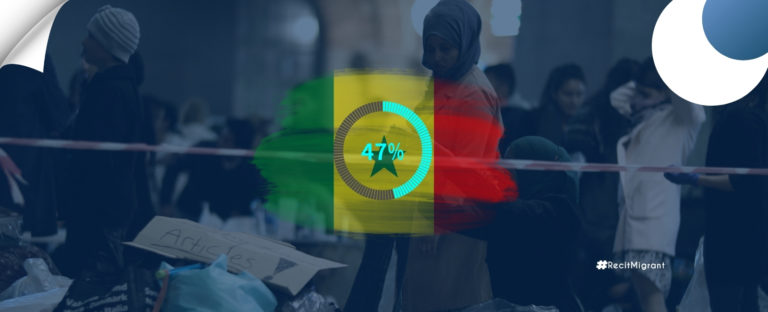
The claim that women make up 47% of international migrants in Senegal is often held up as proof that migration is becoming more female. It deserves a closer look. Behind this figure, which people repeat without context, lies a more complex reality shaped by global forces and stubborn inequalities.
On 3 March, UN Women Senegal posted on Facebook that women make up 47% of international migrants in Senegal. It is a striking figure. The organisation points to international databases, notably the Migration Data Portal and the United Nations Department of Economic and Social Affairs. These bodies rely on one key indicator: the international migrant stock, which counts everyone living in a country other than the one where they were born at a given moment.
But we still need to understand what that means.
The migrant stock is a snapshot, not a flow. It captures how many people live outside their country of birth at a single point in time. It says nothing about recent departures, and nothing about whether female migration is rising right now.
This distinction matters. UN figures draw on censuses, administrative registers and projections, so they remain estimates. They also struggle to capture certain realities, such as irregular migration or the most precarious journeys. Senegal, meanwhile, is still a country of net emigration. More people leave than arrive, and this is a long-term, structural pattern that goes well beyond the moment.
The data confirm as much. In 2024, net migration stood at around 10,307 people, which shows that departures outpace arrivals. Yet these numbers, too, belong to a long-term trend rather than to the present alone. Despite several requests, neither the Ministry of the Interior nor the Directorate of Senegalese Abroad provided further data on the subject.
Behind 47%, gender dimension
The value of the 47% figure lies less in what it claims to prove than in what it reveals: women now stand at the centre of migration. For a long time, they remained invisible or filled supporting roles. Today they are actors in their own right. They migrate to work, to support their families or to win a measure of independence. But statistical visibility must not hide the very real inequalities they face.
In practice, migrant women remain more exposed to precarity. They cluster in informal sectors such as domestic work and petty trade. They also face greater risks of violence, exploitation and discrimination. Near-parity in the figures, in other words, does not mean equal conditions.
That is the heart of the matter. By suggesting a balance, this kind of data can feed a misleading picture of migration. We therefore need a gender lens, both to understand these journeys and to protect the women who now shape them.
The 47% figure tells us nothing about the journeys, the constraints or the power relations that run through them. Behind the statistics lie human realities. And those realities, more often than not, escape the averages.