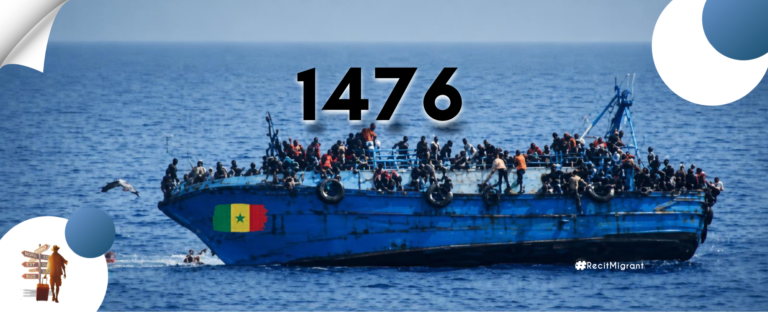
Between April and May 2026, the International Organisation of Migration recorded 1,475 people involved in movements through the Canary Islands route, 880 of whom were preparing to leave. A few months later, the rescue of 1,046 people who had sailed from The Gambia served as a reminder of the risks inherent in this crossing. Hidden behind the figures and statistics are personal life stories, experiences of violence and life plans that paint a different picture of West African migration.
On the Canary Islands route, departures are not merely documented by images of wooden boats at sea. They are also reflected in the data. As part of its monitoring of departure points in Senegal, IOM recorded 32 incidents in connection with migratory movements between April and May 2026. Eight migrant departures and one canoe spotted on the high seas were recorded. A total of 1,475 people were concerned by these movements. These figures, published in September by the IOM’s Displacement Tracking Matrix (DTM), help to better document part of the movements along the West African Atlantic route. But behind every figure lies a journey, a decision to leave and a plan sometimes taking several weeks to prepare.
The number of people already involved in the preparations is particularly striking. Over the period examined, 880 people were implicated in preparations for departure, according to IOM. Six cases of migrant recruitment were also reported. Therefore, the journey does not begin when the canoe leaves the coast. It begins long before. It is organised on land, through connections, savings set aside, middlemen and networks that facilitate the organisation of the journey. For every boat that sets sail, there may still be others eagerly waiting or procrastinating or preparing to set off.
A Still Active Route
The West African Atlantic route continues to be one of the main migration corridors used by people from West Africa, seeking to reach the Canary Islands in Spain. Departures mainly take place from the coasts of Morocco, Mauritania, Senegal and The Gambia. Nevertheless, arrivals in the Canary Islands have declined slightly. According to data from Spain’s department of Home Affairs cited by IOM, 1,544 migrants arrived in the Canary Islands by sea between April and May 2026, compared with 1,559 during the same period in 2025, a fall of around 1%. Yet this decrease does not mean the end of departures.
A few months after the period studied by IOM, a large-scale rescue operation served as a stark reminder of the risks associated with this route. During the last week of August, 1,046 people who had attempted to reach the Canary Islands aboard seven vessels were rescued and brought ashore at Nouadhibou, Rosso and Dakar. The boats had set sail from The Gambia and were bound for the Canary Islands, around 2,000 kilometres off the West African coast. As they found themselves stranded at sea, those on board were rescued and brought back to the mainland. In Dakar and Rosso, teams from Médecins Sans Frontières (MSF) provided them with the necessary assistance in collaboration with IOM.
Once in Dakar, Emergency Care Follows the Trauma at Sea
When the survivors reach land, the figures become real persons in need of medical care. MSF teams took care of people suffering from extreme dehydration, severe exhaustion, loss of consciousness, broken bones and skin, stomach or respiratory infections. Among the 1,046 people rescued were 134 women, including a pregnant one and 88 kids. Some were out at sea for so long that they were found in a pretty bad condition. With the shortage of their food and water supplies, their bodies just couldn’t cope. Yet, the trip’s impact went far beyond physical injuries.
Some survivors told the medical teams that they had watched loved ones dying during the journey, a trauma situation which prompted MSF teams to offer mental health support in addition to medical care, and to transfer the most serious cases to dedicated facilities. Then no wonder that the crossing leaves scars that are hardly visible. A person may be brought ashore alive, yet they’re still carrying the trauma of what they’ve just been through at sea.
Violence Erupts Even Before Boarding
Most of those rescued came from Senegal and The Gambia. Others were from Mali, Guinea and Côte d’Ivoire, amongst others. Whilst being attended to, several told MSF teams that they had suffered acts of violence in their country of origin or along their migration route. In Dakar, one survivor reported being beaten up by a people smuggler and other men in order to extract more money from him for the crossing. One woman also recounted that a people-smuggler had collected the money intended for her journey before raping her. These accounts reveal that the risks do not necessarily begin the moment the boat leaves the coast. For some people, the migration route is already marked by violence long before they even set out to sea.
Data from IOM provide a glimpse into departures and the preparations they entail. These data alone do not provide a clear insight into what drives a person to risk their life in a 2,000 kilometres journey. This is where the accounts of those rescued add another perspective. According to MSF, many of those cared for explain that they took this route to escape violence or extremely harsh living conditions in their country of origin. “When people embark on a 2,000-kilometre journey – currently the deadliest in the world – it is because they are fleeing a far worse fate, says Dalil Adji, head of mission for MSF’s migration task force in West Africa.
Between a Drop in Arrivals and Continued Departures
The available data thus paint a contrasting picture. On the one hand, arrivals by sea in the Canary Islands fell slightly between April and May 2026 while on the other hand, data collected by IOM in Senegal show that departures are continuing and that hundreds of people are still making travel arrangements. The rescue at the end of August reminds us that behind these movements there are people facing significant risks. The route is therefore not merely a line between the West African coast and the Canary Islands but also a journey that begins on land, continues at sea and may end in a healthcare facility in Dakar, Rosso or Nouadhibou.
Figures Behind Journeys
32 incidents, eight departures, 1,475 people involved in these movements, 880 people preparing to leave and six reported cases of recruitment. IOM’s data helps to document part of the migration patterns on the Canary Islands route. They show that departure is a process that happens long before boarding. Yet they do not tell the whole story. Beyond the statistics lie the people preparing for their journey, those who give up, those who set sail and those who return to shore after being rescued. In late August, the 1,046 people who disembarked in Senegal and Mauritania provided a concrete example of this reality. On the Canary Islands route, therefore, departures are also reflected in figures. But behind every figure lies a migration story, a life plan and, at times, an ordeal whose after-effects linger long after the return to the mainland.