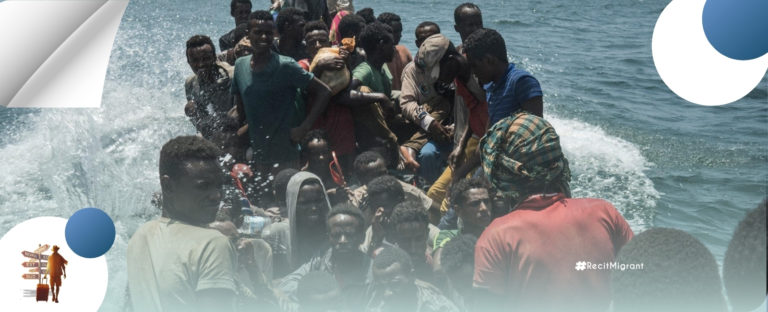
At least 139 migrants died when a boat sank off the coast of Djibouti during the night of 8 to 9 October 2026, according to the International Organisation for Migration (IOM). This incident highlights the persistent dangers of the Eastern migration route, used by thousands of people heading for Yemen and the Gulf states.
The boat was carrying 305 people when it sank near Guehere, north of Obock. The death toll, initially put at 109, has risen to 139 following the retrieval of a further 30 bodies. Some 84 people are still unaccounted for and 82 have survived.
According to the IOM, this is one of the deadliest shipwrecks ever recorded on this route. The tragedy comes as migration flows along this route remain high. According to the IOM’s monitoring report covering January to March 2026, 152,700 movements were recorded on the Eastern Route, compared with 141,000 during the same period in 2025 – an increase of 8 per cent. According to the organisation, these movements are expected to remain high in the coming months, as a result of economic hardship, food insecurity, household debt and a lack of livelihoods. These reasons partly explain why migrants leave, but they do not, on their own, fully account for the persistence of this route. Employment prospects in the Gulf states also play a part. For many migrants from the Horn of Africa, Yemen is a stepping stone to Saudi Arabia and other destinations where they hope to find work.
Data on arrivals in Yemen confirm the scale of these movements. In an update published on 12 October 2026, the IOM reported that it had recorded 134,100 arrivals of migrants between January and September, 22 per cent more than the 110,144 recorded throughout the whole of 2025. In 2024, this figure stood at 60,897.
A study by the Mixed Migration Centre, published in August 2025 and based on 1,645 interviews with migrants in Yemen, sheds light on the conditions of their journeys. It highlights an almost widespread use of people-smugglers amongst those interviewed. According to the research centre, this dependence stems in particular from the lack of regular migration routes and the challenges of overland and sea crossings, which require knowledge and resources to cross borders whilst circumventing controls. The role of people smugglers is therefore not limited to organising transport. When travel options are limited, migrants may rely on middlemen to continue their journey, without necessarily being aware of the conditions of the crossing or the risks to which they are being exposed. This vulnerability can leave them more prone to abuse, exploitation and accidents. However, it does not mean that all migrants undertake the journey for the same reasons or have the same resources at their fingertips.
A Perilous Route Beyond the Crossing
The risks do not end at sea. In its report for the first quarter of 2026, the IOM also recorded 94 deaths and disappearances on the Eastern Route, 61 of which occurred in Djibouti. The organisation also reported that up to 1,000 migrants were stranded near Obock, facing food and water shortages following the suspension of certain crossings and against a backdrop of harsh weather conditions.
In Yemen, migrants must also reckon with a situation of conflict and a deteriorating humanitarian crisis. The IOM highlights risks of detention, forced displacement, trafficking and exploitation, as well as limited access to healthcare and protection services. For those hoping to travel on to the Gulf states, arriving in Yemen does not therefore necessarily indicate the end of their hardships. Following the shipwreck in October, the organisation has been providing emergency assistance to survivors at its Migrant Response Centre in Obock, including healthcare, psychosocial support, food, shelter and protection services. Amy Pope, the organisation’s Director General, is calling on governments and donors to take action before another tragedy occurs. She is pleading for regular migration routes, believing that they can help save lives.
IOM figures show that the Eastern Route remains a major migration corridor despite the loss of life and documented risks. To reduce such tragic events, responses must take into consideration the constraints that drive people to leave, the expectations that guide their choices and the conditions under which they undertake their journey.