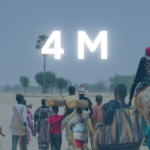

The sinking of a boat off the coast of Djibouti, which claimed the lives of at least 139 people in October 2026, highlights the dangers of a migratory route taken each year by tens of thousands of people from the Horn of Africa. Behind these perilous crossings are hopes of finding work, economic hardship and a lack of secure prospects for the future.
At least 139 migrants died and 84 others were reported missing after a makeshift boat capsized off the coast of Djibouti during the night of 8–9 October 2026. The boat was carrying 305 people bound for Yemen when it sank near Guéhéré, north of the town of Obock, according to the International Organisation for Migration (IOM).
Among the bodies recovered there were 15 children. Around 82 people survived, according to information provided by the organisation. Search and rescue operations are ongoing, whilst IOM teams are providing assistance to the survivors at the Obock Migrant Response Centre. Those rescued are receiving, amongst other things, healthcare, psychosocial support, food, shelter and protection services. This tragedy ranks among the deadliest shipwrecks recorded on the so-called ‘Eastern Route’. It serves as a reminder that, for many migrants from the Horn of Africa, the search for a better future can begin with a journey whose outcome remains uncertain.
The Eastern Route: a Migratory Transit Corridor between Africa and the Middle East
Every year, tens of thousands of people leave the Horn of Africa to reach Djibouti, cross the Gulf of Aden and make their way to Yemen. This route, which takes them through the Bab el-Mandeb Strait, is mainly used by Ethiopian and Somali people. For many, Yemen is not necessarily the final destination. It serves as a stopover on the way to the Gulf countries.
Djibouti plays a strategic role along this route. Situated between the Horn of Africa and the Arabian Peninsula, the country has become a major transit point for people undertaking this journey. Figures released by the IOM highlight the magnitude of these movements. Between 1st January and 1st October 2026, the organisation recorded around 178,000 arrivals in Djibouti from Ethiopia. More than 20,000 additional arrivals had been recorded since 10th September. These figures underscore the significant role of this migration corridor. However, they do not necessarily mean that everyone who arrives in Djibouti goes on to make the crossing to Yemen.
Poverty, Insecurity and Climate Change: Understanding the Reasons for Departure
Why take the risk of boarding a makeshift vessel to cross a dangerous sea? There are many factors driving migrants to choose this route. The IOM points in particular to poverty, insecurity and the growing consequences of climate change. For some, leaving is driven by the need to find work and provide for family members. For others, economic hardship is compounded by insecurity, precarious livelihoods or deteriorating living conditions.
Against this backdrop, the Gulf states appear as destinations offering opportunities for income. The hope of securing employment can cause people to accept particularly dangerous travel conditions. However, it would be misleading to regard all these journeys as identical. Migrants’ reasons for leaving, financial resources, circumstances at the time of departure and future plans differ depending on the individual and their situation. Understanding these differences is key to analysing the region’s migration dynamics. The use of makeshift vessels also highlights the risks to which travellers are exposed even before reaching their destination: shipwrecks, disappearances at sea, injuries and the interruption of their migration journey.
Instable Yemen: a Stopover on the Way to the Gulf States
The decision to take this route may seem somewhat paradoxical. Yemen continues to be plagued by persistent instability, yet it remains a transit point for migrants hoping to move on to other countries in the region. This situation highlights a contrast between the risks of the journey and the prospects migrants hope to find at its end.
For some, Yemen serves as a transit point. For others, the hardships encountered along the way can lead to a prolonged stalemate. People who no longer have adequate resources or who run into obstacles preventing them from moving on may then find themselves in a situation of great vulnerability.
The IOM highlights that many migrants remain stranded in Djibouti as a result of the risks associated with their journey. Transit is therefore not merely a geographical stage: it can also become a period of waiting, uncertainty and dependence on humanitarian aid. This reality serves as a stark reminder that migration policies must take into account the entire journey, from the country of departure to the transit and destination point.
Over 900 Fatalities or Missing Persons in 2025
The shipwreck in October 2026 is the latest in a sequence of tragedies along the Eastern Route. According to the IOM, more than 900 migrants died or went missing on this route in 2025. These statistics highlight the persistent dangers on a route that is nevertheless taken by a significant number of people every year. Search and rescue operations remain essential, as do support for survivors and the search for missing persons. However, emergency responses alone are not enough to reduce risks in the long term.
IOM is therefore calling for additional funding for rescue operations and emergency aid in Djibouti. It also advocates for the establishment of safe and legal migration routes. According to its Director-General, Amy Pope, the increasing number of such tragedies must compel governments and donors to take action before another shipwreck occurs.
The increasing number of tragedies on this route therefore calls for a response that combines emergency relief, protection of migrants, regional cooperation and the development of safer migration routes. For as long as people believe that the risks of a dangerous crossing are worth taking rather than facing a lack of prospects, the Eastern Route will continue to pose a fundamental question to states: how can migration be made safer, without ignoring the reasons that drive people to leave?