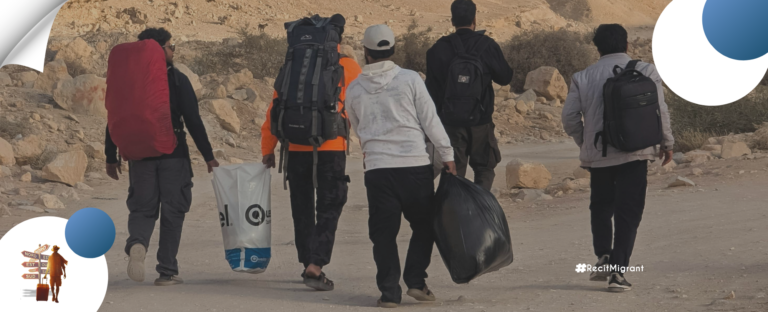
Mixed migration involves the movement of individuals across borders who are fleeing persecution, conflict or trafficking, or who are seeking new opportunities. Driven by a range of factors, these populations share routes and modes of transport that are often irregular, whilst suffering multiple infringements of their rights.
The report by the Mixed Migration Centre for the second quarter of 2026 highlights the complex nature of these flows in West Africa. Against a backdrop of heightened security restrictions, shifts in routes to Europe and persistent humanitarian crises at the heart of the Sahel, the analysis of migration flows reveals significant changes that directly affect Niger, Mali and Burkina Faso.
Niger: Dealing with deportations and border redesigns
In Niger, the migration situation continues to be shaped by the scale of forced returns and regional instability. Between 18 January and 17 May 2026, at least 14,602 people were deported from Algeria to Niger, according to Alarm Phone Sahara. These deportations, which account for nearly 43 per cent of the record figure recorded for the whole of the previous year, involve Nigerien citizens as well as nationals from Mali, Guinea, Nigeria, Sudan and Chad. Agadez remains a key hub where many migrants are stranded and living in precarious conditions.
Meanwhile, border management is seeing major diplomatic developments. The authorities in Niger and Benin have begun talks to reopen their shared border, which has been closed since 2023. Niger has set out strict requirements, including a defence agreement, a joint intelligence framework and greater transparency regarding the foreign military presence in Benin. During this closure, people-smuggling networks have adjusted their tactics by making greater use of small boats on the River Niger to get around the obstacles.
Internally, Niger is also feeling the repercussions of the crises in its neighbouring countries. The country is hosting a growing number of refugees whilst seeing part of its population affected by the spread of cross-border insecurity.
Mali: between internal insecurity and cross-border displacement
Mali is one of the region’s most volatile hotspots.
In late April 2026, large-scale coordinated attacks carried out by non-state armed groups hit strategic centres, from Bamako to Kidal. This violence disrupted road networks, caused supply shortages and triggered population displacement, notably the arrival of Malian refugees in Niger and internal displacement in the Kayes region.
The situation in Kidal, a strategic crossroads near the Algerian border, illustrates the fragility of the territorial balance. Armed groups controlling a given town is a major impediment to the movement of goods, humanitarian access and transit routes to Algeria.
Furthermore, Mali is struggling with a dual displacement dynamic.
On the one hand, in May 2026 the country was hosting nearly 294,000 refugees and asylum seekers, a significant increase driven by arrivals from Burkina Faso and Niger. On the other hand, the Bandiagara region, particularly Koro, is seeing a continuous influx of thousands of Burkinabe refugees fleeing violence in their country of origin.
This increased concentration of displaced people is placing greater strain on local infrastructure and basic services.
Burkina Faso and the regional shockwave
Burkina Faso remains the main point of origin for refugees and asylum seekers in the central Sahel. Persistent insecurity is driving thousands of civilians to cross borders to seek refuge in Mali, Niger and the coastal States.
In Benin, the dramatic increase in the refugee population is largely attributable to the influx of Burkinabe nationals, whose numbers have risen sharply to over 27,000 by May 2026. This situation clearly shows that instability in Burkina Faso is reshaping the asylum landscape in West Africa, shifting part of the humanitarian burden onto the States of the Gulf of Guinea.
Global trends and changes in migration routes
At regional level, the data suggest a shift in routes to Europe.
Arrivals via the Atlantic route to the Canary Islands fell by 67 per cent in the first half of 2026, totalling 3,708 people. However, this drop in arrivals does not mean there has been a decrease in attempts to leave. Interceptions continue in Mauritania, Senegal and The Gambia, whilst the number of deaths at sea remains high.
In response, migrants and people-smuggling networks are turning to alternative routes. The Western Mediterranean route has seen a 26 per cent rise in arrivals, with Algeria confirming its role as the main point of departure. At the same time, the European Union is continuing to externalise its controls, as illustrated by the new return regulation adopted in June 2026, which provides for transfer centres in third countries.
Analysis of these flows shows that mixed migration in West Africa is not merely a matter of transit statistics. It serves as a warning sign of the security, political and economic crises gripping the Sahel, requiring structural responses that go beyond simply tightening control policies.