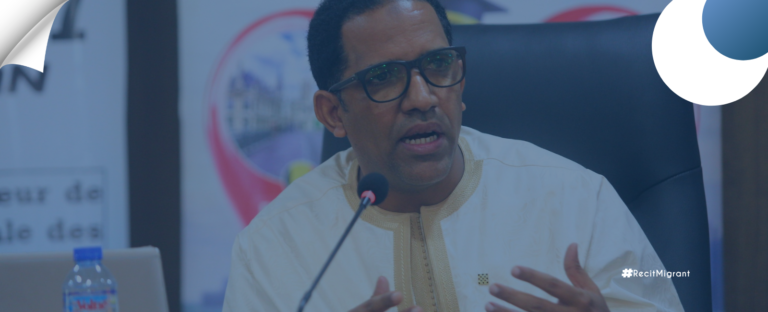
The migration of minors, whether accompanied or not, poses a serious challenge to African states and international organisations alike. Balancing protection, security and public responsibility is a delicate task. To shed light on it, we spoke to El Hadj Baba Wangara, a police superintendent working on child protection.
How does children’s rights law address migration?
The answer lies in the International Convention on the Rights of the Child, a treaty ratified by almost every country in the world. This universal body of law applies to all children, whatever their circumstances.
Any migration policy must follow three principles: the best interests of the child (Article 3), non-discrimination (Article 2) and respect for the child’s views (Article 12).
In Africa we often talk about child protection, yet pay little heed to children’s own opinions. Every child, though, has the right to be heard. We need a shift in mindset to give children a real say in matters that affect them.
Why do children migrate alone?
You often meet children of 15 or 16 along the routes. It matters to understand why. In the Sahel, severe security crises are common: armed violence, extreme poverty, school closures and limited access to healthcare. Children flee these realities.
Some are simply trying to survive. Others hope to reach education or to support their families. I have seen children walk kilometres just to get to school. When conflict shuts the schools, migration becomes a survival strategy.
There is also a supposedly “positive” side: the chance of personal growth and access to university and to economic opportunity. But that hope often hides grave dangers.
What are the main dangers these children face?
The risks are many and severe. One is forced recruitment into armed groups. In parts of the Sahel and Central Africa, children are seized by these groups. Adolescents of 14 to 16 are armed, radicalised and manipulated.
Trafficking is another, involving sexual exploitation, forced labour and domestic servitude. Girls under 16 may be exploited as domestic workers abroad, sometimes unpaid for months.
Work in the mines is a further danger. In some mining areas of Mali, children work to fund their journey to North Africa. Child labour in such conditions is banned.
Criminal networks and smugglers play a big part too, offering protection, manipulating debt, making spiritual threats and applying community pressure to exploit children.
Finally, abandonment and extreme violence are common. Some children are left behind in the desert. The scenes witnessed during rescue operations can be unbearable.
Unaccompanied or separated children, what’s the difference?
It matters to distinguish the two.
An unaccompanied child has no parent or legal guardian present.
A “separated child” is with an adult who is not their parent or legal guardian.
The distinction is essential in order to put the right protection in place.
Is there a legal framework?
Yes, and an extensive one.
At the international level:
- the International Convention on the Rights of the Child;
- the Global Compact for Safe, Orderly and Regular Migration;
- the Global Compact on Refugees;
- the principle of non-refoulement.
At the African regional level:
- the African Charter on the Rights and Welfare of the Child;
- ECOWAS and African Union guidelines on the protection of unaccompanied minors.
These instruments place clear obligations on states, including providing alternatives to detention, adopting a child-sensitive approach and strengthening protection.
What role do security forces and international cooperation play?
We need stronger cooperation to fight criminal networks. In Europe, for instance, Frontex plays a pivotal role in border management.
But the answer cannot be control alone. We must also invest in local capacity in Africa, through training, regional cooperation and community-based prevention.
Children’s migration cannot be handled through security mechanisms alone.
Advocacy, choosing protection over hardship
Absolutely. We run awareness work to help young people grasp the real dangers of irregular migration.
But we must also invest in education, guarantee access to basic services, fight poverty, support families and strengthen child-protection systems.