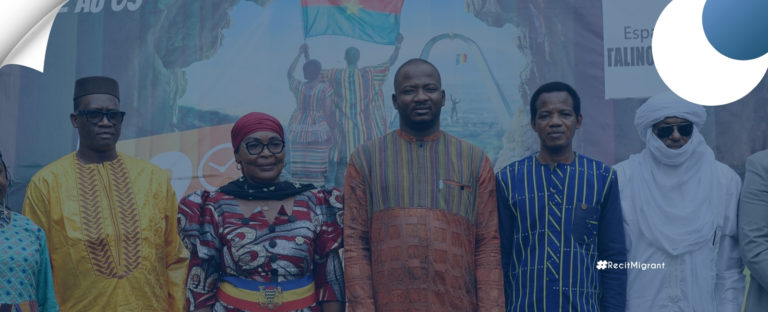
For four days, Burkinabè culture came to the heart of N’Djamena, Chad’s capital. Behind the flavours, the fabrics and the sounds, the ‘72 Hours of Burkina Faso in Chad’, held from 2 to 5 April 2026 under the theme ‘Burkina Faso at the heart of authenticity — my plate, my pride’, sketched a different reading of African mobility, far from the dominant tales of exile and borders. The event formed part of the third National Days of Patriotic Commitment and Citizen Participation.
In the aisles of the craft village at the Talino Manu space, in the southern district of N’Djamena, a closeness takes shape that reaches beyond nationality. Amid lengths of Faso Dan Fani, handmade objects and traditional dishes, Chadian, Burkinabè and other visitors move from stall to stall, share a meal and swap memories. The scene is simple, yet it says a great deal. It tells of a rooted, everyday mobility, made of living side by side and of exchange.
For the organisers, the event should become a space where people meet. Alimata Ba, who chairs the organising committee, insists on this. The ‘72 Hours of Burkina Faso’, she says, are not only a cultural showcase. They form a bridge between two peoples whose bonds have grown over time. Between Chadian hospitality and Burkinabè roots, a relationship of closeness and mutual respect comes through.
Beyond the celebration, the event also carries an economic vision. The stalls are not only places to exhibit; they are places of opportunity. Crafts, food, textiles: in each of these sectors, local initiative meets the promise of collaboration. The aim is to spark partnerships between Chadian and Burkinabè entrepreneurs, in a spirit of shared development. Official speeches echoed the point. The Ambassador of Burkina Faso to Chad, Boukaré Zoungrana, praised the diaspora’s engagement and underlined culture’s central role in bringing peoples closer. In a Sahel marked by security and economic strain, he recalled the importance of regional solidarity, notably within the Alliance of Sahel States. The values on show, ‘fraternity, unity, solidarity’, cross national borders and point to a wider identity shared across the Sahel.
Cultural cooperation with political overtones
The Chadian authorities struck the same note. For Abdoulaye Souleymane Babalé, Secretary-General of the ministry in charge of culture, the event reflects a truth often plain on the ground but rarely told: these are peoples bound by a shared history. “We have the same roots,” he says, pointing to a closeness that is not only geographical but a matter of collective memory. His words carry particular weight at a time when people so often reduce African mobility to its irregular forms. In N’Djamena, the ‘72 Hours of Burkina Faso in Chad’ offer another view. Here, mobility is not a rupture but a continuity. It belongs to patterns of settlement, movement and taking part in the social and economic life of the host territory.
The four days’ activities carried the point further. Exhibitions, food, craft demonstrations: each is a way to pass on, celebrate and share know-how. By stressing local consumption and culinary identities, the organisers also joined a wider conversation about food sovereignty and economic patriotism. At its core, the event revealed something public debate often misses: a migration that brings people together, that builds and that takes part in the life of societies. A migration made of settled families, of social networks, of everyday solidarity.
Through the ‘72 Hours of Burkina Faso in Chad’, the Burkinabè diaspora does more than celebrate its identity; it claims its place in a shared space, where borders fade and human bonds take over. In a Sahel searching for its bearings, this kind of presence says something different about migration. It reminds us that migration can also be a story of roots, of transmission and of living together.