At Môle 3 in the Port of Dakar, the final curtain fell on an ambitious pan-African series. Combining hard-hitting fiction with support from the security forces, this 300 million CFA francs project aims to use cinema as a powerful tool for raising awareness.
The final shot was filmed at Môle 3 in the Port of Dakar on 3 September, following several months of filming in Dakar, Thiès and Lompoul with the filming crew of ‘Beyond the Mirage’ officially wrapping up production on a series that aims to explore irregular migration beyond mere statistics and public discourse. The wrap-up ceremony brought together public authorities, international partners, film industry insiders, and security forces.
Directed by Amary Fall, known as JAHman, and financed by Synopsis Group and MD Prod, the production consists of ten 42-minute episodes. It received support from the Joint Operational Programme II (JOP II) ‘Aar bakkan – Samm yeleef’ and was co-funded by the European Union.
Within the port area, the final clapperboard strike was far from a mere cinematic ritual. The sequence filmed on this final day sets the tone with a canoe that had set off from Penc Mi being intercepted at sea by the security forces before being brought back to the port of Dakar. The migrants are rescued. Fifi, who had come to find out what was happening, learns with relief that they have all survived. Mapenda, who had tried to melt into the crowd of would-be travellers, is identified and arrested. A fictional scene that directly reflects a reality in Senegal that has become a matter of serious concern.
Initially, the project had a different title: “Community Radio”.
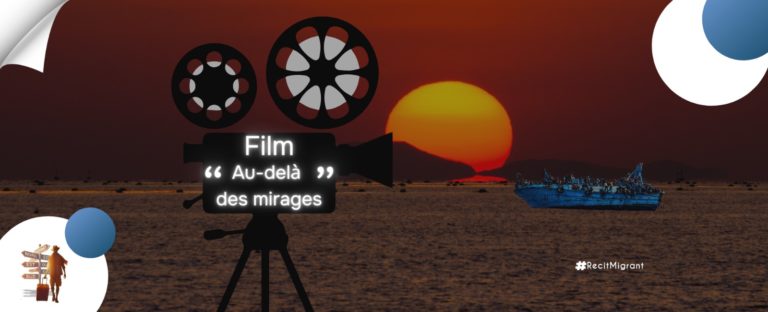
But as production unfolded, the team chose to move beyond the narrow confines of a radio station and a single region to explore the underlying causes of these departures ‘Au-delà des mirages’ thus touches on the promises of a better life, the romanticised image of Europe, the promises made by people-smugglers and the narratives circulated on social media. For Amary Fall, this evolution of the title better reflects the project’s ambition.
The filmmaker praised the support provided by POC II and the European Union, noting that their involvement made it possible to produce a work dedicated to an issue that goes beyond statistics, the causes of irregular migration, its effects, the networks of people-smugglers and, above all, the human lives behind the figures.
A Film Worth CFA 300 million
The making of the film also required a substantial investment. It is reported that over CFA 300 million was mobilised, with more than 40 technicians and over 200 actors and performers involved. Originally scheduled to last two months, the shoot ultimately ran for three months. For JAHman, this endeavour reflects a clear ambition that is to shoot in Senegal with Senegalese professionals, support local businesses and meet standards that will enable national productions to reach beyond national borders.
But for him, the final shot does not mark the end of the adventure. JAHman is already considering the possibility of a second series, which could broaden the narrative to include the realities experienced both before departure and after arrival, with the aim of continuing to challenge the myths that fuel dangerous migration journeys.
One of the project’s particular features lies in the direct involvement of the National Police and the National Medical Gendarmerie. Equipment, filming spaces, staff and technical advice were made available to bring the fiction closer to operational realities.
This collaboration was widely praised at the ceremony. For the Minister for the Interior and Public Security, Mouhamadou Makhtar Cissé, this contribution marks a new way of using cinema as a tool for advocacy. He described the series as a pan-African work focusing on irregular migration and welcomed the fact that the security forces are entering the field of audiovisual production to reach a wider audience.
His message is clear: irregular migration is not just a matter of national borders. It affects families, communities and society as a whole. The Minister reiterated Senegal’s position on the Atlantic route to the Canary Islands and the tragedies regularly reported in that area. Behind the boats, the statistics and the disappearances, lives are being turned upside down and it is precisely this human perspective that the film aims to bring to the fore.
For her part Mame Coumba Diop, Secretary of State for Culture, Creative Industries and Historical Heritage, paid tribute to the successful completion of several months’ hard work. She emphasised the complexity of a production on this scale including travel arrangements, coordination of teams, and technical and human constraints.
The project had also received 25 million CFA francs in funding from FOPICA. For the Secretary of State, however, this experience underscores a broader need: that of considering sustainable funding for the Senegalese film industry. She considers ‘Au-delà des mirages’ to be a demonstration of the talent of local professionals, but also an opportunity to strengthen Senegal’s position as a filming destination and centre for audiovisual production in Africa.
The casting, which brings together Senegalese actors and several talents from the subregion, supports this mission. The film stars include Amélie Mbaye, Issaka Sawadogo, Roger Sallah, Ramata Cissokho, Abdoul Karim Konaté, Sokhna Fatou Bakhoum (known as Linguère Fifi), Dial Thiam, Lamine Cissé, Boucounta Mbaye and Mac Mic.