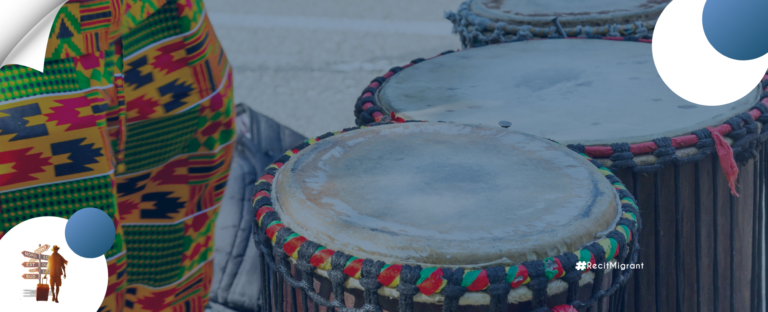
On Saturday 19 September 2026, Bordeaux vibrated to the sound of the Sabar. Gathered around the drums, dancing and singing, Senegalese people from the diaspora shared a moment of festivity, cultural transmission and renewed connections. Within the circle, different generations mingled, whilst people from Bordeaux with various backgrounds also found themselves carried away by the Senegalese rhythms. Far more than just a dance event, the Sabar has become a meeting spot for Senegal and the French city of Bordeaux.
From the very first beats of the percussion, the mood changes in Place Saint-Michel. Conversations ceased, eyes were turned towards the dance floor, and the first dancers stepped into the circle. The drum set the pace and bodies responded accordingly. The Sabar then began. For several hours, Senegalese dancing event transformed the space into a genuine meeting place. The rhythms suddenly accelerate, the movements become more refined, the dancers energetically perform together, while the public accompanies every move with applause. Shouts of joy and cheers fill the air. With the Sabar event, nobody really remains a motionless spectator for very long.
Inside the hall hosting the cultural event, the outfits are what first catch the eye. Women wear splendid traditional Senegalese garments, colourful boubous fabrics with vibrant patterns. Some will sit for a few minutes before springing to their feet when their preferred rhythm begins to play. Unable to resist the drum beats, one woman quickly adjusts her headscarf, flashes a smile at a friend sitting nearby and joins the dance floor while another one claps her hands in harmony with the beat before taking to the floor herself.
The attendees are by no means exclusively from the Senegalese community. People living in Bordeaux but from other backgrounds are also present. Among them there are several White people discovering or rediscovering the Sabar. Some stand back at first, observing the movements and conventions of the dance, before letting themselves be swept up by the ambiance. A few even try out a few steps, cheered by the dancers and the attendees to join the dancing floor. Their presence gives the evening a special flavour. Sabar is deeply rooted in Senegalese culture, but it is also becoming a space for interaction with the residents of Bordeaux. People watch, learn, chitchat and, sometimes, dance together.
Women At the Heart of The Festival
Women play a significant role amongst the participants. Some have come to dance, others to catch up with loved ones or simply to spend time with the community. Each, in her own way, relates the special connection that Sabar has with her own history. As Fatou Mbaye, who lives in Bordeaux, explains: “When I hear those drums, I feel right at home. Even though I live in Bordeaux, for a few hours, I feel as though I’ve been immersed in the atmosphere of festivals in Senegal.”
Sabar is a cultural practice that is deeply rooted in Senegalese society. It tells a story, passes on traditions and brings different generations together. In Bordeaux, it has taken on a new meaning: that of a culture which travels with those who have left Senegal and who continue, despite being in France, to keep their traditions alive. For Senegalese women who have been living in France for several years, these gatherings have become priceless occasions as they provide an opportunity to reconnect with a familiar setting, practice Wolof, meet other women and share memories. “We’ve come here to dance, but that’s not all. We catch up with people we know, meet new people and, above all, stay connected to our culture,” Aminata Diop says.
A Dance That Cut Across Generations
In the audience, various generations mingle. While the older women immediately recognise the familiar rhythms and movements, the younger ones tend to watch, sometimes capturing the moment with their phones, smiling, before eventually joining the circle. Some have learnt from their mothers, aunts or grandmothers. Thioro Guèye confides, “The Sabar brings back memories of my childhood. In Senegal, dancing is part of many important life events. Here, when I dance, I think of my family back home.” The circle then serves as a space for passing on traditions. A movement is demonstrated, copied and corrected. A rhythm is recognised. A new generation, in turn, takes on a tradition inherited from their parents and grandparents.
Culture Never Stands Still
At the heart of this festival, the percussionists perform a vital role. Their drums do not merely set the beat for the dancers; rather, they engage in a dialogue with them. A sudden acceleration sparks a new movement; a change in rhythm prompts a dancer to adjust her steps. Each sequence becomes an exchange between the music and the body. The performers’ eyes meet. A dancer steps forward into the middle of the circle. She performs a few movements, pauses, then picks up the pace as the drummers restart the rhythm. Around her, the applause grows louder. She smiles. The audience smiles back. For a few seconds, all eyes are on her. This connection with the rhythm is almost instinctive.
“You might be tired, or have had a hectic week, but as soon as the drum starts, something changes. You’re filled up with new energy. You forget everything and let yourself be carried away by the music” according to Fatou Mbaye. This relationship between the drum and the dance is what gives Sabar its full emotional intensity. The rhythm seems to guide the bodies, but the dancers, too, respond to the music and help to craft the performance. Aminata Nathalie Ndiaye, a young Senegalese woman from Bordeaux, sums up this connection to her roots in this way ‘I was born here, but when I dance Sabar, I feel that it’s also a part of me. It’s a way of connecting with my origins beyond the stories my parents tell.’
When Culture Creates Connections
But beyond the dance movements and percussion plays out another story: that of the Senegalese diaspora in Bordeaux. Migration does not, after all, necessarily mean a total disconnect from one’s culture. If anything, it can foster new avenues for passing on cultural heritage. In Bordeaux, Senegalese culture is reflected in community associations, gatherings, meals, cultural events and, of course, in music and dance. The Association of Senegalese in Bordeaux (ASB), founded in May 2026, officially includes among its objectives the promotion of Senegalese culture in Bordeaux and the Nouvelle-Aquitaine region, fostering solidarity amongst Senegalese nationals in the region, organising cultural, sporting, educational and social activities and strengthening ties between the diaspora and Senegal.
“When you arrive in a new country, you can feel lonely. These kinds of events allow you to reconnect with a community, talk to women who are going through the same sorts of experiences and feel less isolated,” explains Aminata Diop. For the Senegalese women gathering that evening, the celebration will leave a lasting legacy: memories, new connections, but also the sense of having contributed to keeping a culture alive far from their homeland.