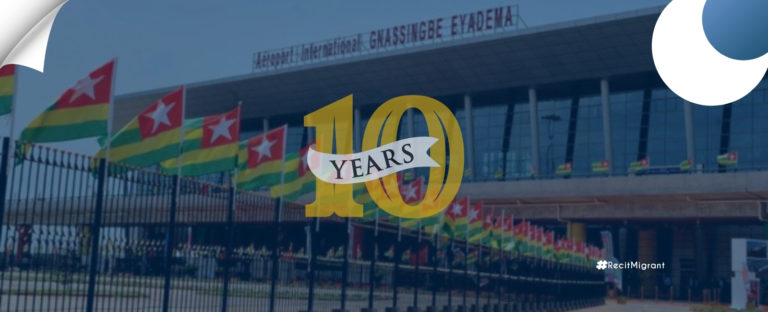
At Gnassingbé Eyadéma International Airport, a symbolic new chapter is opening. Ten years after its new terminal came into service in 2016, Lomé’s airport is steadily emerging as a key hub in West Africa. Behind the traffic figures and the expansion plans, ever more significant migration dynamics are taking shape across the sub-region.
Economic mobility, the movement of workers, student migration, regional transit, an opening to new African markets: Lomé airport is becoming far more than a transport facility. It stands as a strategic crossroads of Africa’s contemporary mobilities.
Hub at heart of regional mobility
Since it opened, the modern terminal has transformed Togolese air transport. Planners first designed it for nearly 2 million passengers over fifteen years, yet it grew far faster than expected.
In just five years, passenger traffic doubled to around 1.6 million travellers a year. The rise reflects both Togo’s growing appeal and the intensifying movement of people across West Africa.
As intra-African migration grows, Lomé is becoming a major point of connection between several regional spaces: West Africa, Central Africa, Southern Africa and, at times, the Middle East or Europe.
Today, many of the travellers passing through Lomé are migrant workers, students, traders, entrepreneurs and international civil servants, or migrants in transit to other African destinations.
This fits a continental trend in which African migration is mostly intra-African. According to the International Organisation for Migration, more than 70% of African migration takes place within the continent.
ASKY Airlines, engine of African mobility
This dynamic rests largely on ASKY Airlines, now one of the main tools of regional connectivity.
Based in Lomé, the airline has built a dense network that links several African capitals through dozens of daily flights. That position turns Lomé into a genuine sub-regional air hub.
Beyond commercial results, the model feeds the movement of skills, economic exchange, professional mobility, university links and cultural ties.
Where African integration remains a challenge, air connectivity stands out as a major lever for the free movement of people, driven notably by the Economic Community of West African States (ECOWAS) and the African Union.
Lomé, city of transit and migratory crossroads
Many passengers stop in Lomé for only a few hours before flying on to other African destinations. This transit pattern reflects how African migration routes are changing.
Long focused on Europe, African mobility is gradually reorganising around regional economic poles. Cities such as Lomé thus become strategic spaces of movement.
Air freight and logistics are growing alongside this shift. Trade tied to economic migration is expanding, notably with traders who move between several African countries.
The airport becomes a place where economic dynamics and movement, labour migration, business tourism and the African diaspora all meet.
Investment to support new forms of mobility
Faced with this growth, the Lomé-Tokoin Airport Company is already looking ahead.
It is studying several major projects: extending the current terminal, building a new one, strengthening logistics infrastructure and improving the capacity to receive passengers.
These investments answer a clear reality: African mobility will grow strongly in the decades ahead.
Several African and international projections suggest that the continent’s youth, urbanisation, trade and regional integration will drive a considerable rise in intra-African movement.
From this angle, airport hubs are becoming strategic tools of regional competitiveness.
Migration, economy and appeal
The airport’s growth also feeds the local economy directly.
The planned 165-room ‘DoubleTree by Hilton Lomé Airport’ shows the drive to capture transit travellers and strengthen the site’s appeal.
Around the airport, hotel services, logistics, direct and indirect jobs, business opportunities and foreign investment are gradually developing.
This shows that mobility infrastructure now plays a major role in economic development policy.
Regional ambition in competitive environment
By 2045, the Togolese authorities are aiming high: 5 million passengers a year.
But that ambition sits in a fiercely competitive region. Several West African capitals also want to become major air hubs.
For Lomé, the task will be to keep costs competitive, connectivity strong, service attractive and conditions stable for investors.
As mobility becomes an economic and geopolitical issue, airport infrastructure plays a central role in African integration.
Symbol of Africa’s new mobilities
After ten years in operation, Lomé’s terminal is entering a phase of strategic maturity. The task is no longer only to raise traffic, but to give that growth a lasting shape.
In an Africa where human mobility is multiplying and diversifying, Gnassingbé Eyadéma International Airport now stands as a symbol of the continent’s new migration dynamics.
Between regional integration, economic mobility and the movement of talent, Lomé is working to secure its place among the continent’s major air crossroads.