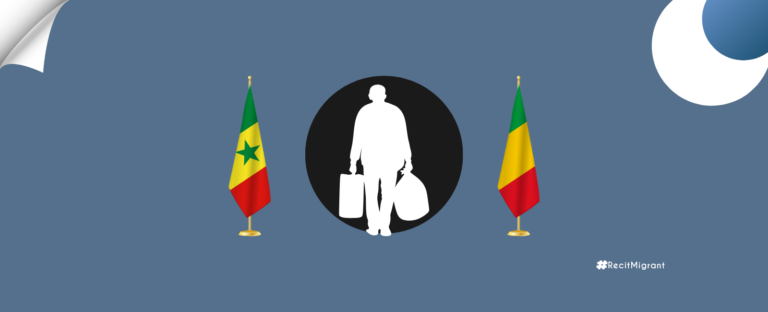
After leaving Senegal as a teenager, Ibrahima Ndour built a life in Bamako, complete with a family and an identity that spans two cultures. His path from tailor’s apprentice to master craftsman speaks to successful integration and to the idea of a borderless Africa, where the heart matters as much as origin in defining who you are.
In Senegal, people nickname him “Malien”. His real name is Ibrahima Ndour. Few in his Bamako neighbourhood know that he was not born Malian. His story begins elsewhere, across the border in Senegal, in a modest family where he learnt the value of hard work from an early age.
“We didn’t talk much at home. My father taught us to work hard,” he says simply.
He was only about fifteen when he left home. He was still a slight teenager then, his eyes full of hope and his hands already marked by his first stitches. A tailoring apprentice, he had joined his maternal uncle in Mali to build a future.
“I didn’t know exactly what awaited me, but I knew I had to move forward,” he recalls.
The beginning was hard. In Bamako, he had to adapt to the rhythm and codes of the city, to its warmth and its demands. Ibrahima watched a lot, spoke little and learnt fast. In his uncle’s workshop, he spent whole days hunched over fabrics, repeating movements, correcting mistakes and perfecting his cuts.
“At first I made a lot of mistakes. But I learnt something from each one,” he explains.
In the evenings he would listen to conversations and take in the sounds of Bambara. Little by little the words became familiar, then second nature.
“I learnt Bambara by listening. It’s the language of the clients, so I had to master it.”
More than fifteen years have now passed.
Ibrahima is no longer the quiet apprentice he once was. He has become a master of his craft. In his Bamako workshop, colourful fabrics tell the story of his journey, from rich bazin to fine cotton and delicate embroidery. Every piece he creates carries his unmistakable signature.
“When I cut a piece of fabric, I’m not just making a garment, I’m telling a story,” he says proudly.
He is known above all for his menswear, from elegant boubous to modern takes on traditional outfits and ceremonial dress. His demanding clientele comes from across the city and from the Malian and Senegalese diaspora, and it includes influential figures. They value his precision and his eye for detail, and his gift for blending tradition with modernity.
“My clients trust me. I have to live up to that trust every time,” he says.
Although he works mainly for men, he does not turn away orders from women.
“Fabric deserves the same respect, whoever I’m working for,” he adds.
Physically he has changed little; he is still short, with a deep, dark complexion and a reserved manner. But his gaze has grown more confident. He speaks Bambara fluently, jokes with clients and negotiates with suppliers. He is living proof of successful integration.
“Today I feel at home here. Mali has given me so much. This country is part of my story,” he says.
Mali is no longer just his host country. It has become his home, a place where he has found fulfilment. Over the years he has naturally built a circle of friends, most of them Malian.
It is also where he started a family. His wife, who is from Senegal, shares this dual sense of belonging. Their meeting in Bamako feels like a twist of fate: two paths that began in the same country, crossing elsewhere to build something together.
“We found each other far from home, but in the end we made a home here,” he says with a smile.
They are now raising two children, a son and a daughter, who are growing up steeped in several cultures and languages. Switching from Wolof to Bambara, and recalling Senegal while talking about daily life in Mali, comes naturally in their home.
“I want my children to know their roots, but also to embrace Africa and the wider world,” he explains.
For all his sense of belonging, Ibrahima never forgets where he comes from. Every year, after Tabaski, he returns to Senegal. The trip is more than a visit; it is a ritual.
“When I go back, I become the neighbourhood child again. It reminds me why I started,” he says, his voice full of emotion.
He reunites with his parents, takes in the familiar surroundings and reconnects with his roots. A few months later he returns to Bamako, where the life he has built awaits him.
At heart, Ibrahima embodies something larger than himself. His journey reflects a continent in motion, where borders are not barriers but passages.
“To me, Senegal and Mali are one and the same. They’re the same family,” he says simply.
Through his life, he shows that intra-African integration is not an abstract idea but a lived reality, built on hard work, adaptation, mutual respect and achievement.
He did not choose between Senegal and Mali. He connected the two.
When asked whether he plans to return to Senegal to open his own workshop, he pauses before answering.
“It’s in my plans, but after so long in Mali, I’m not quite ready yet, not psychologically. Mali is the country of my heart.”
And so, to the steady hum of his sewing machine, the story of dignity, perseverance and African unity keeps unfolding.