
Niger is an economy on life support. In Tahoua and Zinder, thousands of households depend almost entirely on the financial support of relatives working abroad. A study by the IOM in October 2024, which surveyed 2,345 migrants, indicates thatthe money sent home is used for food, healthcare and school fees. There is almost nothing left over for construction purposes.
The report highlights a missed opportunity whereby migrants desire to invest, start businesses, and contribute to local development. But reality quickly catches up with them. Prohibitive transfer costs, administrative red tape and a lack of state support stifle entrepreneurial momentum. Money circulates, alleviating immediate problems, but it does not create sustainable jobs. These figures reveal more than financial trends; they expose the fragility of regions where circumstance and failing public services force the diaspora to step in.
Direct support for basic needs
Funds transferred by migrants are almost universally used to meet basic needs. In both regions, nearly 98% of transfers are used to finance food and household expenses, illustrating the direct role migrants play in their families’ daily survival. Two critical social sectors also benefit from a significant proportion of these remittances: health and education, with notable regional disparities.
According to this study, 57% of funds are used for health expenses. This proportion is significantly higher in Zinder (66%) than in Tahoua (48%) reflecting greater health vulnerability and pressure on household health expenditure in Zinder.
Focus group discussions confirm that migrants primarily finance individual healthcare and the purchase of medicines for their families. However, participants in Zinder complained about the lack of solid health infrastructure and the absence of a structured community health system. In Tahoua, individual contributions have sometimes enabled health centres to be equipped and basic health infrastructure to be renovated, although capacity remains limited.
Education accounts for 42% of overall fund utilisation. Once again, Zinder (52%) has a significantly higher share than Tahoua (32%). This difference may indicate either a greater priority being given to education in Zinder, or disparities in the cost of and access to education. Transfers are primarily used to fund the education of siblings or cousins. However, communities emphasise the urgent need for collective infrastructure. In Tahoua, migrants have organised contributions to build classrooms, particularly those who have left for Côte d’Ivoire. This has helped reduce overcrowding in some schools.
Migrant investment,paradox between intention and actual impact
Analysis of funds originating from migration reveals a persistent gap between their financial potential and actual capacity to bring about structural change in the local economy. While these flows are vital for daily consumption, they still struggle to become embedded in a sustainable development approach in terms of both infrastructure and the productive fabric.
Investments in basic infrastructure, such as housing and wells, remain marginal, accounting for only 13% of overall initiatives. Although the Zinder region is slightly more dynamic than Tahoua, there is still an urgent need for improvement. In light of this, communities are expressing a strong desire to direct this capital towards collective projects, particularly in the areas of health and education, ideally through co-financing with local authorities.
Conversely, a paradox is hindering the growth of the private sector. Although 73% of returning migrants claim to have invested in their communities, indicating a desire to contribute to the economy, only 6% of remittances actually reach local businesses. Consequently, economic initiatives remain confined to micro-entrepreneurship and self-employment. These structures tend to be fragile and very small: more than a third are individual projects with no employees, and almost all of the rest employ only one or two people. As businesses capable of generating more than five jobs are the exception, the impact on sustainable job creation is limited for the time being.
Investment sectors: Trade, agriculture and transport.
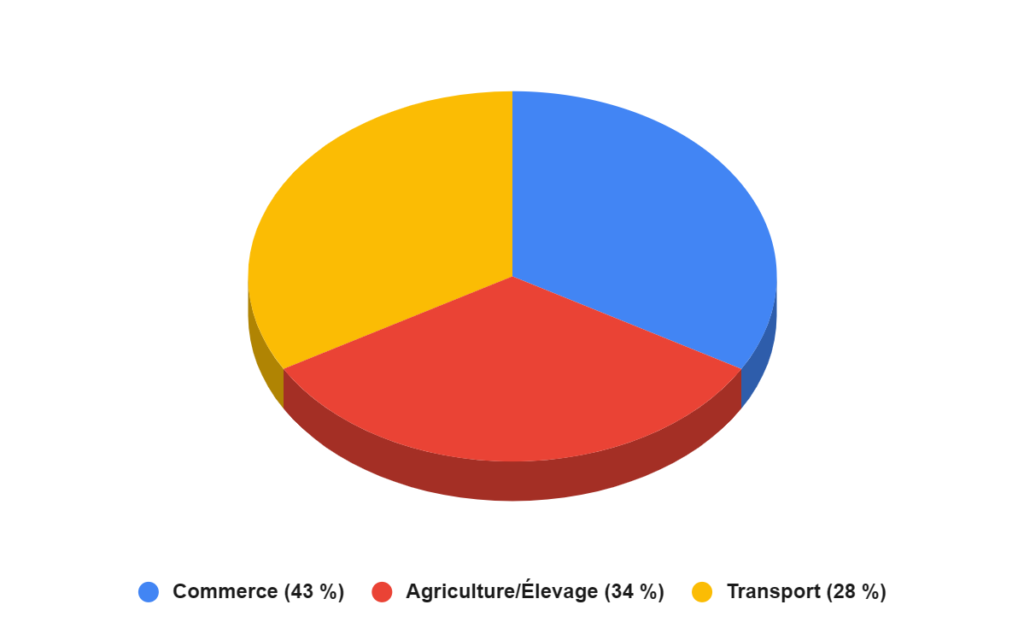
Investment sectors vary by region. The Zinder region stands out for its economic diversification, with a particular focus on trade (46%), agriculture (40%) and transport (27%). In contrast, Tahoua has a dynamic focus on trade (41%) and transport (30%), but relatively low agricultural investment (27%), despite its rural potential.
Crafts remain under-exploited, accounting for only 13% of projects in both regions.
Migrants’ initiatives face structural obstacles that limit their impact on local development. Almost half of migrants (48%) experience difficulties when sending funds.
High transfer costs are the main constraint, cited in 71% of cases, particularly in Tahoua (78%). Additionally, 83% of returning migrants cite a lack of capital as the primary obstacle to starting their own business.
The administrative environment and lack of public support also hinder investment.
- Administrative difficulties relating to licences and authorisations are more prevalent in Zinder (27%) than in Tahoua (25%).
- A lack of support from local authorities was mentioned by 45% of migrants in both regions, reflecting a perception of insufficient institutional support for migrant entrepreneurship.
Action point: improve reintegration programmes
The IOM reintegration programme has benefited 26% of surveyed migrants. It is generally perceived as useful (75% consider it very useful).
However, there are regional disparities and weaknesses.
| Desired improvement | Total | Tahoua | Zinder |
| Increase financial assistance | 87 % | 87 % | 88 % |
| Strengthen follow-up after the programme | 67 % | 61 % | 74 % |
| Offer more tailored training courses | 58 % | 51 % | 65 % |
Satisfaction is greater in Tahoua (81%) than in Zinder (70%). In Zinder, criticisms mainly concern the quality of training, the lack of follow-up after the programme and insufficient funding. The Tahoua model, which is based on training and entrepreneurial support, seems to better meet the needs of economic sustainability (41% of participants in Tahoua received support compared to 23% in Zinder). In Zinder, the predominance of financial aid without sufficient supervision limits the expected positive effects (63% of participants in Zinder received financial aid compared to 44% in Tahoua).
The data highlights the urgent need to strengthen dialogue, simplify procedures, and establish microfinance schemes tailored to returning migrants. Better local governance of resources generated by migration is essential to transform individual contributions into a real lever for the sustainable development of the Tahoua and Zinder communities.
The money is there. The will is there. What remains missing is an effective mechanism. For migrant remittances to move beyond serving as a social safety net and begin fuelling sustainable economic growth, families cannot shoulder the burden alone. Without a substantial reduction in transfer costs and the creation of a genuinely investment-friendly environment, this financial inflow will continue to dissipate in the immediacy of daily needs.
The responsibility now rests with public authorities to transform family solidarity into a structured engine of national development, before the resilience it sustains is gradually eroded by the very precarity it is meant to offset.